Showing posts with label Africa. Show all posts

Monday, August 21, 2017

Congratulations Kyura and Inno Part 2: Good-bye Home

There comes a point in most people's lives when their home becomes their parent's home. Growing up, it is collective, my home, meaning mine and my parents and my siblings and whoever else lives there with us, it's ours. But at some point, that group doesn't include you anymore, and your home is no longer yours; your home is some other place where you stay without all those other folks. For myself, and I think for a lot of us in the U.S. who first leave home for college, that transition happens sort of gradually. You have a dorm or maybe even an apartment where you stay at school, but home is still your home. Maybe you have still have a room there, or at least most of your stuff accumulated during your first 18 years, possibly even still being added to with new accumulations that you just don't really need in your dorm. Eventually, you go, move to another place, take a few more things. At some point, your parents turn your room into a guest room, or an excessively gigantic sewing room bursting with fabric, patterns and sewing machines. You start confusing your friends by calling that place, where you used to have a space, and wherever you stay now "home," meaning it equally for both. And someday, you find yourself saying to your sisters, "are you going to Mommy and Daddy's today?" and you realize you're quite dispossessed of your home and you aren't even really sure how it happened. For Kyura, however, that transition was a big bright line that she could mark almost down to the minute.

Day 2: Good-bye Home

Good Friday had been a strange mix of lackadaisy and bustle during the day. Kyura's family's home in Jos was as full of people as the house in the village had been, perhaps even more so.

Friends bustling and chillin

All the female friends were posted up in the room Kyura and her sister had shared growing up. Lounging on the beds; taking tea from trays, sipping sweet gulps of Milo and chewing soft white bread; taking turns disappearing to bathe with buckets of water scooped from the large plastic cans stored in the corner of the large bathroom, plastic cans restocked throughout the day with fresh water drawn by two young men hauling rubber bag-full after rubber-bag full of cool refreshment from the well in the side yard; helping Kyura style her hair, iron her dress---when the power was compliant enough to course through the padded copper wires and into the iron---, and prepare for the day.

Drawing water

The rest of the house was alive with it's own activity. Kitchen staff prepared a constant stream of food for family and guests. The seamstress for the wedding whirled away on a treadle machine in the next room, producing and altering dress after matching orange and yellow dress in an array of styles. 

Like any other bride the day before her wedding, Kyura needed to get her nails done. And like so many other brides, she'd been talked into fake nails that were so very un-Kyura but manageable enough to last through the wedding. We trooped along with her, to the side porch where the manicurist pulled up a stool to do her work in the natural light of the sun. The tube of Chinese nail glue the manicurist bought turned out to be empty, so she ran out to a small shop and quickly returned with a new, and better stocked, package. Relatives came out to the porch to say hello as they passed through the house, aunties and young cousins. A few of us sat on chairs brought out from the sitting room or leaned against the porch rail, chatting while the manicurist did her craft and the boys in the yard hauled up water. Kyura fielded phone call after phone, mini-crisis after mini-crisis: calls from friends looking for places to stay for the wedding, the printers not having the programs ready for Inno to collect, the reception decorators not seeing the transferred funds in their bank accounts due to the Easter banking holidays. Kyura handled it all calmly from her porch throne.

Later in the afternoon, the groom's family would be coming to ask for Kyura. Inno's uncles would apply to Kyura's uncles for their niece to leave her home and come to theirs. If there was a set time for this, I have no idea when it was, but being Nigeria, if there was a set time for this, it's unlikely the uncles came anytime near that time. The sitting room filled with family elders from both sides, arranged on the thick sofas and chairs in a large circle. Kyura's sister brought out snacks and beverages and served each person. home, no longer her home.

Dancers

Outside, male elders with jingly metal bands fastened around their ankles sang and danced in a circle. Others joined, from the house? from the town? There were so many people everywhere I wasn't sure where most had come from. I joined, we danced until the group suddenly fell quiet.  Discussions began. I snuck in the back with the seamstress, hiding rather conspicuously on a tall bar stool behind a pushed-aside dining table, watching, not really understanding much more than that this was important and solemn and emotional. Kyura was called in and kneeled before her parents. Before long, she was being led out of the house, shrouded in a veil, another

Procession (to the car) to the church
procession of singing and dancing, another car ride away from home to a new place. Away from

At the request of the groom's family, Kyura's family had given her over to the custody of the church until the wedding morning. She, her maid of honor and her eldest aunt would stay at the church, in the care of the best man and the groom's family, until the morn. We followed on foot. The church where the wedding was to take place was separated from Kyura's parents' house only by a lane, and a very large cement wall on the edge of that lane. For tonight, Kyura had no home; her parent's house was no longer hers, and her husband's house was not yet hers. For tonight, she was to make do in the guest house of the assistant pastor. And make do it would certainly be.

The assistant pastor's guest house, or perhaps it was to be a servant's house, was a small one-room cement building out back of his home on the church property. It had an en-suite restroom divided from the room by a curtain. Kyura's wedding dress was hung from the curtain rod, tulle and beads pressing against the protective coating of the clear garment bag, saving the pure white dress from the dust of the walls. There was no furniture, just two old mattresses, one on the floor and one against the wall, the one against the wall in far worse condition. Kyura's aunt took one look at it and sent someone for a mat from the family home. A mosquito net hung matted in a twisted ball and low above the laid-out mattress. Agreement was quickly made not to let the net free for fear of what might fall, or crawl, out of it. Another runner was dispatched to the home for bug spray. The room had a single window next to the door. An electric fan was courried from the house. There was one outlet. Even when the power was on, it didn't work.

Best man trying to make the fan work

The best man arrived with a screwdriver, removed the outlet and attempted to wire the fan's plug directly to the wall. It still didn't work; probably a blessing that these wires were lifeless! A solution was concocted in the form of multiple power strips and strings of wire run in a line over from the assistant pastor's house, a plastic bag wrapped around the part where bare wires were twisted together on the ground outside. It worked, at least when there was electricity in general. A battery lantern was fetched from the house.

The groom's family brought dinner. Rice and some sort of soup or stew, tea. Dishes were fetched from the house. We sat on plastic lawn chairs that had been brought in. Kyura and the maid of honor sat tepidly on the floor mattress. We chatted and laughed and amused ourselves with the ridiculousness of this place as a bride-to-be suite. We laughed at the Nigerianess of everything about the room and the on-and-off electricity and the broken outlet and the creepy mosquito net and the scary mattress against the wall and the huge number of friends and family helping with everything and the perfect-despite-it-all haze that surrounded every piece of the events leading up to the big day. And we bid goodnight to Kyura, her aunt, and the maid of honor, to sleep as best they good, as we retired to our own lodgings until the morn. Sheets and blankets were fetched from Kyura's parents' house.

Saturday, August 19, 2017

Congratulations Kyura and Inno Part 1: A Proper Village Send-Off

Back in April, I went to my friend Kyura's wedding. We hadn't seen each other since attending a conference together in Uganda in 2010, so when she invited me to her wedding, I just had to go, even though it meant postponing an already long-overdue visit back to Zambia. But I have found that attending friends' weddings is really important to me. Even if I hardly get to see them during the festivities, just showing up often means so much. This one was extra special because I actually got to spend a ton of time with the bride.

The wedding festivities took place over four days, beginning with a send-off ceremony and celebration for the bride, culminating with the wedding itself, and ending with a special thanksgiving for all their blessings.

Day 1: The Send-Off

I arrived in the village with one of Kyura's friends, shuttled there by a trusted driver who was willing to take us hours down the road from Kaduna and off the paved highways to the family's village. Looking around, I could see how much wealthier Nigeria is than Zambia. I'd never been in a Nigerian village before. There were powerlines running through the sky, nevermind that they probably were lifeless more often than live; metal roofs on every house I could see; everyone had shoes, even the children; and the roads, though dirt, were in decent condition. The family house was large and cement, with elegant columns lining the porch, like a plantation home, or a country estate for old British landed gentry. Of course, either of those would have been lacking the corridors full of stored water in 50-gallon drums and 20-liter gerry cans, the rumbling of the generator whirling electricity to cell phone chargers and lightbulbs, and the plastic patio chairs on which village women sat pouring local maize drink into empty plastic bottles. Nonetheless, I was impressed.

Kyura and her friends were inside. The house was full of people, many of them bustling, preparing food and drink and clothes. Others, like myself, lost in the action, sitting on plush sofas in the dim parlor, chatting tentatively to strangers who would be good friends in a few days, eating lunch? dinner? a snack? something anyway, from plastic plates on our laps. A giant bowl of cooked cucumber and tomato salad(?) makes for an interesting whatever that insert-appropriate-eating-session-here was. I eventually found my way to the real action, where Kyura's closest friends, and the day's chiefmate, were helping her get ready for the send-off celebration. This would be the day for her family's village to officially say good-bye to her, to send her from her home to the home of her husband. It was like a giant wedding reception for just the bride. There was even a cake cutting.

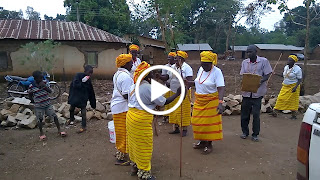
Kyura wore a long green skirt decorated with lace and beads, an intricately beaded ivory top and a head wrap bordering between yellow and ivory dotted with green rhinestones. A group of elder village women arrived at the family house dancing and singing, yellow wrappers with orange stripes and white shirts a unifying dress code, corn-husk-and-seed rattles tied around their ankles provided percussion to accompany their voices as they stepped forward and back, holding long sticks in as they sang. They led the procession from the family house to the school grounds where the send off would be. As they danced, Kyura rode behind in a car, saving her long dress and new shoes from the mud of the morning's rains.


Dancing at the Send-Off

The school grounds were decorated with canopies and bunting in white, seafoam and evergreen. Guests of honor---family, friends, local dignitaries---sat under the canopies. Rows of villagers lined the edges of the school yard. Kyura's close friends who were accompanying her sat under a white canopy, surrounding the satin covered sofa where she and her chiefmate sat. An MC in the center of the yard led the celebration: dancing and prayers, one group then another, dignitaries, father's family, mother's family, friends of the bride, the groom's family, etc. Each was called up in their turn to dance with the bride-to-be, to shower her in cash, everything from 10 naira notes to 1000s, none of which the bride deigned to pick up. There was a special cadre of pre-teen girls for that. Dressed in black and white, they would swoop into the dancing masses and scoop the bills into cardboard box lids, taking their full lids to a special side place where they'd empty them into bigger boxes and return to the dancing for refills.


Prayers are offered for the bride

Village leaders, politicians, religious leaders and family members came forward to say a few words. I couldn't understand all the words as much of it was in the local language and some in Hausa, but the happy and joyful sentiments were obvious no matter the language. Kyura's parents told her how very proud they were of their dutiful daughter. She wasn't the only one crying.

Dinner under the canopies

While the dancing continued, plates of jollof rice, chicken, moin moin, salad, and I-don't-even-know-what-else-cuz-it-all-has-meat were passed around to those under the canopies. As the festivities wound down, brightly-colored styrofoam take-away containers of food were passed out to the villagers. Notebooks, buckets, plastic basins, and other keepsakes we would refer to here as swag were passed out to attendees on behalf of the bride's family, the groom's family, friends of the bride, aunties, etc. Guests were also giving presents, bringing them to the white canopy with the satin couch, wrapped packages in all kinds of shiny paper, and even a bright pink potty-chair---can't beat planning ahead.

As the celebration at the school grounds ended, the festivities continued back at the family house for those who weren't exhausted. The rest of us, including the bride and most of us friends, hit the hay, or foam rather, for a good night's sleep. Tomorrow we would travel into Jos.

Saturday, April 22, 2017

Africa

WP_20170414_115Africa is raw.  Tangible, raw life.  Every box, every line we draw in the West is washed away in a cloud of red dust.  Africa is freedom.  Freedom of the truest sort where life is burrowed so deeply into the very essence of the world that one becomes the expanse of the deep blue sky, breathes the heavy deep rustling of the large mango tree leaves, is powered by the strength of the ancient volcanic rocks that dot the landscape like hoards of mythical sleeping beasts, and wears that deep red dirt that creeps into every nook and cranny of every being and everything.  Distinctions between seeming opposites, such as indoor and outdoor, disappear altogether.  Everything comes from the earth in ways in which one cannot help but be acutely aware.  Water pulled from the earth, dinner roaming the earth, the sun being the best and most reliable light of all.  The earth is yours and you are the earth’s.  And everyone moves together in it, all a part of it.  What appears to be narrow two-lane roads become four or five or six lanes as pedestrians, bicycles, motorbikes, three-wheel scooters, cars and lumbering lorries surge together, sweeping between and past and among each other.  People cut through when they have a chance and make way when others need room in a gracefully understanding manner one would never see in places where people feel entitled to whatever bit of road they’re on as though it belongs to them and only them simple because they are there.  Life has not had the living sanitized out of it.  Numbness cannot survive.  Alertness, awareness, oneness with everything around you is a must.  But such exertion is not exhausting; it is invigorating.  It is living.

Thursday, August 25, 2016

Birth and Death

A message with an apology and “I didn’t know how else to reach you,” is never one with good news.  Especially not when it comes from someone so far in your past you honestly probably wouldn’t have remembered them if someone had asked you to name everyone that was part of your life that particular year.  You might have remembered them with respect to their role in your life---oh yes, and there was the new volunteer who replaced me at my site---but not by name.

Yet, when that name popped up on my Google Chat, I knew exactly who it was.  I knew the name lingering inside the chat window’s large block of text even more: Ba Joyce.

Ba Joyce.

Ba Joyce.

One of my bamaamas, my Zambian moms.  Bamaamas are like kids I think; you’re not supposed to have a favorite.  Maybe there’s an exception for the one that bore you; that one can be your favorite.  But the ones that are your other bamaamas, the ones that help raise you (even when you’re already grown), and feed you and teach you how to cook and wash and speak Tonga, and live.  The ones you wish you’d asked to teach you how to pee standing up.---I understand the concept; I was just never gutsy enough to try it.---Those bamaamas, I don’t think you’re supposed to have favorites.  But I did.  I had two, and Ba Joyce was one of them.

“I was in Zambia…”

Zed!  Oh, Zed! Just the day before I had been describing Zambia to someone, “Zambia itself will crawl in your heart and never leave. It will burrow like a panya in the grass of your roof, with a scratching that forbids you forget it’s there no matter how infrequently you actually see it.”  At the sight of “I was in Zambia,”  every bit of burrowed Zambia burst forth. 

And then it exploded.

“Ba Joyce recently passed away during childbirth.”

Ba Joyce.

Ba Joyce.

Ba Joyce bore her second son the week I moved into the village.  Her passing through my life bookended by childbirth.  One of those many things we take for granted here.  One of those common, everyday, planned things that used to truly be a miracle.

Ba Joyce.

“Ba Joyce recently passed away during childbirth.” 

“The family is still clearly mourning her loss.”

Ba Joyce. 

Ba Joyce.

The family.

The family without Ba Joyce.

Ba Joyce.

My eyes welled up as my body filled with ambivalence.  Not the American ambivalence of not caring; the British ambivalence of feeling two conflicting emotions at once that I learned from Kryten.  A strange taffy pull that brought even more tears.  Devastation that Ba Joyce was dead.  Elation that others were not. 

Ba Timmy was out in the village, visiting us.  We were nearing close-of-service (COS in Peace Corps parlance), pack-up-your-bags-and-say-goodbye time.  “When are you coming back to visit?”  Ba Lenix had asked.  “Oh, probably in about five years,” Ba Timmy had answered.  Ba Lenix let out a sort of snorty chuckle, a chortle if you will, “We will all be dead.”

I feared he was right.  At 36, he was already past what was then the Zambian average life expectancy.  At that time, the HIV rate in the country was hovering at about 20%.  Simply statistically speaking, a family with one husband and four wives was not an optimistic proposition.  It had only been a few months since I had sat in the shade shelling beans with my favorite bamaamas asking about why one of their others wives had gone to the mission hospital some 20+ km away, since deep and serious eyes had looked at me as a voice tried to laugh a laugh that caught in a throat, since I had heard  “tuyakufwa.”

There was something else, too.  I knew my situation was not like Ba Timmy’s.  Funding a trip to a quasi-remote African village would not be in my near future.  Not in five years, probably not in ten.  When my mother and grandmother came out to visit the year before, it truly had been a once-in-a-lifetime trip.  Even if I were to move back to Africa, I doubt Mommy would visit again.  But then, going to see your twenty-four-year old daughter in a small community she’s made home is very different from visiting your nearly middle-aged child in a block of flats in some bustling metropolis.

I used to write to them, my family, my Zam-fam.  I used to write letters and Christmas cards and little notes to say hello.  I’d send along pre-paid postage vouchers from USPS so they could write back.  “Ndamueya!”  I’d write, “ndamueya maningi!”  I was not lying; I think about them everyday. 

To get mail to the village, I would send it to the post box in Monze, the nearest town, for the government school in Chona, about 10km from our village of Cheelo.  There was a wonderful family who lived in Chona.  The parents taught at the school and the older sons ran the family transport business, carrying things and people and goats to and from Monze.  They would collect the mail and send it over to Cheelo with a passenger who might be going that way.  Perhaps another Cheelo resident or someone passing through on their way to somewhere like Namateba.  But the mail started coming back, unopened, months later, having gone across the Atlantic, through Lusaka, to Livingstone, to Monze and back.  The school had closed its P.O. box. 

Occasionally, I’d meet a Zambian or someone who was traveling to Zambia.  “Can you take a letter for me?”  And I’d hope the magic informal mail system of people who know people going that way would work.  I don’t know if my letters ever made it.

We lost touch.

“Ba Joyce recently passed away.”

Years.  But still, ndabaeya maningi, everyday.  Sometimes, I see them in my dreams.  I see them running towards me as I run towards them, coming up the path past the cattle stall and Ba Lenix’s special cisyu field.  I see them around the fire as we munch on roasted mapopwe.  I hear them yelling “Ba Nchimunya, Ba Nchimunya!” and laughing while my face aches from the stretched smile I simply cannot contract back into fitting on my face. 

Even when I am not asleep, I talk to them.  Imaginary conversations in the shower and on bike rides and in the car and walking down the street.  “Ndaunka ku mbeleka kwa ciinga.”  I’m sure my Tonga is worse than ever, but my thoughts are always in it.  There is no one here to know if I am accidently yelling “prostitutes!” into the air or asking if someone’s menstruated.  I imagine introducing them to Mr. Trizzle, standing sort of scared and unsure on the packed dirt, afraid of what allergens might jump out and bite him.  “Ah-ah, where is Ba Mr. Mindala?”  I try to punt the question.  “ezyi Ba Trizzle, bali benzuma.  Ndabayanda.  Bali kabotu maningi.”  “Ba Nchimunya, muntu isiya?”  Ba Fare would laugh, not really asking a question.  And they would make him feel so welcome and stuff him full of nsima.  The good nsima made from mbusu ground in the village, not that tasteless store-bought mealie meal from town.  And Bay Joyce would hang back a little bit, a huge smile on her face, “Banina Daddy Bunny.  Mwabola?” before coming in for a hug.  “Inzya, ndabola”  I have come.  Finally.  At last. 

But I have not.

And there is no Ba Joyce to smile and greet the mother of stuffed rabbit.

No Ba Joyce.

Ba Joyce.

“Ba Joyce recently passed away.”

Ba Joyce.

No Ba Joyce.

Ba Joyce, Nchimunya and Mazoka

Mazoka, bamaama benu babolide.  Ino, mwakalona lyoonse, antomwe.  Amudokamane.  Pesi, mebo,ndaousa.  Ndamueya, bonse.

Wednesday, February 17, 2016

Revisiting the tear-stained sun

“Her books are very emotionally difficult to read.”  It’s a phrase I say nearly every time I’m recommending one of Chimamanda Adichie’s books, most often for Half of a Yellow Sun or Americannah.  I know it to be true.  I spend a great deal of the time with my head buried in her books also with tears streaming down my face, an angry growl churning in my stomach, my face glowing beet red.  I always assumed it was the subject matter.  Her works contain a lot of violence, sexual abuse, domestic abuse; I mean, it’s war, and difficult relationships, and oppression and such.  It’s not supposed to be easy.  But that’s not the reason.

The subject matter isn’t what makes Adichie emotionally difficult to read.  What makes Adichie emotionally difficult to read is her writing.  She cruelly uses our humanity against us, her readers, plays with and preys upon our propensity to hope.  She presents something to us, makes it familiar, comfortable, happy even-- A calabash providing solid comfort to a terror-stricken young woman on a dilapidated train overcrowded with fleeing refugees; a bouncy baby girl that arrives into our view only a few pages after the characters who have become endeared to us decide together that they want to have a child; the expectant young relative whose joy and excitement is brought to us through seemingly excessive side-jaunts to her far-off village.  But the calabash holds a young girl’s head; the baby is only one of theirs; and the pregnant women are raped and sliced open before they are killed.

Adichie uses our innate hope for the good and beautiful, presenting a world to us that we do not even know is veiled, until we love what we think is there; and she pulls off the veil, daring us simultaneously to love the hideous reality and to hate the beauty we’ve already internalized.

And I simultaneously hate and love, her.  As I turn another page with tears streaming down my face, wishing the book were over, wishing it would never end.

Monday, August 31, 2015

Reflections upon finishing Spectacle: The Astonishing Life of Ota Benga

Sometimes I just hold the pen above the page and wish that it were possible for raw emotion to spill onto it without the need for words or letters or sounds or coherent thoughts.  I suppose artists can do that.  I am not an artist.  I am only human.  An empathetic human fighting to save her soul from the destruction of the masses.  Fighting to find truth despite “the way it is.”

Tears ring my eyes.  The soft patches underneath, beginning to droop with the signs of ma age and lessons of life, are hard with dried salt from tears that escaped some time ago.  Humanity—is anything but.  Cruelty.  Justification  Righteousness for us.  Condemnation for them.

If you want to kill someone, the first thing you do is make them “something.”  Savage.  Negro.  Jew.  Terrorist.  Enemy.  Fetus.  Animal.  Anything but “human.”  Anything but us.  And it is so easy to do.  So easy to draw a line.  So easy to say “me” “not me.”  “Me.”  “It.”  “Me.”  “Those things.”  And once it is done, once the line is drawn, once the leap is made, there is no barrier to the fierceness, the destruction, the uncaring, the harming, the ability to bring pain.

*     *     *

Pain.  Pain.  Pain.

It hurts.

It hurts to receive pain.  It hurts to recognize the immense depths of giving pain of which you are capable.

It hurts to look evil in the face and recognize yourself.  As much as it hurts to look at the broken lying in a heap and see your pain.

I am the broken and the breaker.

I am the shame and the shamer.

I am the victim and the victimizer.

We are.

We all are.

And we call this “humanity.”

And we justify the doing, even as we lick our own wounds.

And there is no end.  Only a new sense of us and them.  Only a new line drawn, even as we express horror at the old one’s place.

Spectacle: The Astonishing Life of Ota Benga purports to be an account of a young man exhibited in the monkey house at the Bronx Zoo in the early 1900s, but it is so much more than that.  It is an unabashed look at global race relations, America’s role in the rise of eugenics and the influence of her preeminent scholars on Adolf Hitler, a gasping account of King Leopold’s horrors in the Congo, and a brave attempt to make an “other” one of “us.”

Tuesday, April 21, 2015

A Lunchtime Visit to Kenya

I didn’t particularly like her story, the one that won the Caine Prize.  I guess it’s good I’m not the judge.  It’s not that I didn’t like her writing – I was rather ambivalent, in the American sense of the word, about it.  But, I didn’t care for the topic.  It was depressing, gruesome, death-filled in its ghost and background characters that were nearly ghosts.  She was going to be reading from that story, and I knew that, but I went anyway.

Some small part of me hoped that hearing the story in the author’s voice would make me like the story more.  The rest of me, well the rest of the part that had caused me to get up from my desk and clip through the dangerously smooth tunnels under the old buildings, justified it as “how could I not go?”  What an opportunity, to take a lunch hour, a common daily happenstance that nearly everyone has, to listen to authors, scholars, intriguing people from all corners of the globe, talk about their passions.

So here I sat, in the Africa and Middle East Reading Room of the Library of Congress, listening to the 2014 Caine Prize winner, Okwiri Oduor from Kenya reading a story I didn’t care for in a dull unpoetic voice.  She would say later in the interview portion, “I used to fancy myself a poet, but now I know better.”  I agreed, and simultaneously felt connected to this young – younger than Munchkinhead – African woman with a style simultaneously flamboyant and subdued echoing of Whoopi Goldberg, thick twists and nose ring with Keds and dreary faded navy capris.
The interviewer started with “When did you start writing?”  Why do they ask this question.  Is there anyone who does not write as a child, anyone who has access to paper and does not take to it with a writing implement?  Of course, Okwiri gave the expected “as a child” answer and then continued.  She spoke of her muses, her influences, her hopes, her reality:  Africa is bustling with young writers and burgeoning support systems, reading groups, writing groups, publishers, etc.  She spoke of rediscovering Swahili literature.  She spoke of the continent, not of Kenya, finally effusing emotion as she expressed her desires for unfettered visa-free travel and the equivalent of “in-state tuition” for all Africans at any country's universities.  A true pan-African.  I shall check back in a decade.  I’ve known many Pan-Africans in their 20s.  By their 30s, they view this idyllic panacea of Pan-ism as foolish.

By the end, I still had no love for “My Father’s Head.”  However, I had found an interest in Okweri as an author and imagine I will seek out her future work, particularly if she returns kuandika kiSwahili as she did years ago.  And I’ll look for her kiSwahili translation of “The Last Wave.”


She’s about to start a writing program at the University of Iowa.  I really wonder how this shy, Afri-centric, bold woman is going to survive in Iowa City.  I expect she’ll find herself rather bored and lonely with few familiarities.  I wanted to hug her and tell her she’s brave for going.

Friday, November 7, 2014

Africa in the Middle of Wisconsin

I turned off the D’banj song and exited my car.  “Baby girl….” D’banj’s lyrics kept going in my head, “I love the way you make your body twerk…”  I stepped into the lobby and was greeted by a 6ft tall cast iron elephant, palm trees and thatched roofed kiosks.  This place is called Kalahari, but the Africaness of its environment hadn’t really clicked as a possibility.  “Oh dear.  What have I gotten myself into?”

The key card clicked in the door, but I hesitated before turning the handle, unsure what I’d find inside.  Every place I roamed in the resort, every first encounter with a new area, a new wall, a new menu, was filled with hesitation.  The Kalahari is simultaneously disappointedly what you’d expect of an African-themed hotel in the middle of Wisconsin and surprisingly delightful.

My room looked like any other hotel room, save for the two framed West African masks hanging near the balcony door.  The hallway outside had also been almost non-descript, save for the wood poles strung overhead like a strange dropped ceiling.  I decided to venture out and take a look around.

Africa mural A long skywalk connected the building where my room was to the main building with conference center, lobby and waterpark.  A detailed mural stretched the full length.  It, like the rest of the hotel, was a combination of “that’s awesome” and “what the?!”  The mural began with a map of Africa.  Missing South Sudan, but otherwise pretty decent.  And a little did you know blurb.  For example, did you know that Africa is almost completely surrounded by water?  Maybe because, oh I don’t know, it’s a CONTINENT?!

A sort series of blurbs, almost tweet-like in their brevity give a small glimpse into a handful of tribes.  Beyond the Intro to Africa section, a trail of Adinkra symbols from the Ashanti culture interspersed with ads for area restaurants and attractions leads you across the skywalk.  “Compassion & Protection are represented in this symbol of a person who teaches another person with patience.”  “CARNIVAL CAFE 24 LANES OF BOWLING, LIFE SIZE BASKETBALL, FOOTBALL AND HOCKEY!” “Humility . Readiness to learn and to WP_20141023_073develop wisdom are signaled with this Adinkra symbol.”  “TOMMY BARTLETT” “Consideration & Tenderness are represented in this Adinkra symbol of a stylized comb.” 

One particular ad caught my eye, for the Ivory Coast restaurant, located somewhere within the hotel.  I wanted to find that restaurant.  A small, likely foolish, part of me thought it possible that the Ivory Coast restaurant might have African food.

As I explored, I found the entire resort complex was filled with art, both African-inspired and authentic African pieces.  Yoruba masks, Kente cloth, bead works, wood carvings, wax prints; you name it, they had something.  Each hallway was a new adventure.

In the evening, after the State Bar of Wisconsin programming was over (you didn’t think I just upped and went to the Kalahari cuz I missed Africa, did you?), I had a chance to explore the water park.  I felt a little odd walking through these art-decked hallways with my citenge wrapped around my swimsuit.  I always pack a citenge when I travel, but if I had known the hotel would be such a mix of Africa and African stereotypes, I wouldn’t have packed the one with the Zambian village scene on it.  I half expected someone to stop me and ask which hotel gift store I got it at.citenge

The water slides were a lot of fun, despite leaving my muscles aching from the thrashing about. And I did eventually find that Ivory Coast restaurant.  There wasn’t a single African thing on the menu, not even some fried plantains.  At least the fun on the water slides and my delight at a real squat rack and bench in the fitness room almost made up for the disappointment on the food front.

Thursday, September 18, 2014

9ja in Mill-town

Thanks to huge heads from my buddy, Midwestphoto, I learned that Milwaukee has a Nigerian culture festival.  Woo hoo!  Now how could I miss out on that?  It was held at the Nigerian Community Center up on Appleton Ave at W. Hampton.  I wasn’t sure what to expect, but I was sure it would be an adventure.

I had to laugh as I pulled up to the building.  The parking lot was being used for the festival, so attendees had to park on the street.  Except the street was under construction.  The far left lane was torn up, a lane of gravel about 4” lower than the street itself, marked off by orange construction barrels.  So where had the Nigerian’s parked?  In the under-construction lane.  They’d just driven between the barrels, gone down the lip and parked on the gravel.  I went the extra 20ft to the end of the block, turned onto the cross street and parked on the empty street.

At the festival, people were milling around inside and out.  Lots of bright colors and a mix of Western and Nigerian clothes, just like in Abuja.  The inside of the community center had something going on in nearly every room.  Outside, a stage area was set up and a row of booths ran down the parking lot from the stage to a giant bouncy castle.

The festival booths reminded me a lot of the booths at the Nigerian Bar Association Meeting I attended several years ago, except without the magical potions.  There were clothing booths with both traditional and club wear, and lots of food vendors.  All of the food vendors were local catering companies.  I talked to a couple of them.  They make the food in their homes and then take it to whatever function has hired them.  As most Nigerian food is not vegetarian-friendly, I had only a couple of fried plantains off my friend’s plate.

We watched two fashion shows: a club wear show and a traditional wear show.  Both shows featured local designers.  The club wear  show models were all grown-ups (thank goodness!), and many of the outfits were rather risque.  There was one white model and in one of the outfits, you could see her lower back tattoo through the dress fabric.  None of the club wear left much to the imagination.

club wear at Nigerian fest (1) cropped

Outfit at the club fashion show

The traditional fashion show models were area students.  They looked awesome.  Some of them were a little shy and it was adorable.  The designer had tried to feature outfits from multiple tribes.  The models had to change very quickly and there weren’t a lot of them, so there was often a lull.  But, the show overall was very nice and well done.  Plus, the soundtrack for this fashion show was all Nigerian music. :)

traditional wear at Nigerian fest (1) cropped

Outfits at Traditional fashion show

Other performances on the stage area included a gentleman playing the talking drum and cultural dancers.  The event was running about 2 hours behind the program schedule (I wouldn’t have expected anything else), so we didn’t stick around for the cultural dancers.

We did, however, check out the story time inside.  That was very interesting.  Gentlemen from different tribes took turns presenting traditional stories from their particular tribes.  Mostly.  There was a great rendition of the story about why the tortoise's shell is cracked.  But there was one guy who got up and instead of telling a story – maybe he did eventually – he went on a 10 minute rant – at least - about how his tribe was the best tribe in Nigeria.  Sadly, this was less surprising than it ought to be.  I don’t know if he ever got to a story because we, like many others in the room, left.

Overall, it was a very fun afternoon.  I felt a bit like I was back in 9ja.  The Nigerian Community Center is having an Independence Day Celebration on Oct. 4th.  Maybe I’ll go check it out.  Maybe I’ll even be gutsy enough to wear one of my traditional outfits.

After enjoying enough Nigerian fun for an afternoon, I went for absolute culture-shift shock and headed to Cudahy for Sweet Applewood Fest. Twenty minutes and a world away.

Monday, July 14, 2014

Adventures with Ivory: Back in the Ville

The Annual Returned Peace Corps Volunteer meeting was going to be held at Vanderbilt.  How could I not go?!

So I called up my friend MattE who had been asking me to come visit him in Nashville.  (He’s currently working on his 3rd Vanderbilt degree, a PhD in Political Science to go with his Masters of Divinity and his law degree.)  It was the perfect trio – MattE, Peace Corps, Vandy.

So I got in Betty and we headed down, and down, and down, until we arrived late Wednesday night, hot, sticky and smiling at Cafe Cocoa where MattE and his friends were gathered.

During the day, I went to the Peace Corps events and got to meet up with some people at the law school that I like to say hi to when I’m in town.  MattE and I were able to hang out in the afternoons and evenings.  He showed me all the changes that have happened in East Nashville – it’s going from ghetto to Hipster-ville a block or so at a time.  We went to a number of restaurants, ones I’d been to when I lived there and ones that were knew to me.  And he introduced me to the girl he liked, who was his girlfriend by the time I left. ;)

MattE just bought a house a few weeks before I came down.  It’s super cute, and he has it really well setup.  It doesn’t look like a bachelor’s pad at all.  It even has a library with patio doors that go out onto a deck, and a very nice guest room with an antique bed he and friend assembled.

The Peace Corps events were fun, too.  I found a friend from Cali, the president of the NorCal RPCV group, and we were able to hang out a bit.  He introduced me to some other RPCVs he knows, one runs a chocolate company based in Madagascar.  Neat.  I met lots of other RPCVs over the weekend, including some that served in Nigeria.  It was interesting to talk with them because they served in the 60s.  The city I lived in in Nigeria wasn’t even built until the 90s.

I also met some recently returned volunteers from Zambia!  I know Zambia’s changed a lot in the past ten years; that much I can tell from Twitter.  It sounds like the program I was part of in the Peace Corps has also changed a lot.

Overall, Nashville was a great trip.  I had a lot of fun, enjoyed beautiful weather, saw old friends from different areas of life and picked up a present for Mzzzz Jones’ expected little one.  I also found out about some opportunities to go back to Africa in an IP context…

Friday, May 2, 2014

Tears of 9ja

I am sad today.  I am sad for Nigeria.  It is a beautiful country full of sparkling people.  Sure, they do yell a bit – watch any Nollywood film, they really do talk like that – but every Nigerian I’ve met has been super generous.  From the colleagues at the office to the people who opened their homes to me and the strangers on the street who welcomed me to their country, Nigerians love to share, their world, themselves.

The country has had a rough history.  It’s known the world over for corruption and scams.  Internet scams are so highly associated with Nigeria that their name even comes from the Nigerian criminal code, 419.  They’re civil war, only 50 years ago, is still fairly palatable.  - Half of  a Yellow Sun by Chimamanda Adiche gives a superb insight into this part of history.  -   There’s been military coups and a stream of changing governments.  So many hardships it’s almost easy to shrug off new difficulties.

Yet this past month, the craziness Nigeria is facing seem to be too much.  Is it because of the sheer number of people kidnapped in the school girls’ kidnapping?  Is it because the bomb blasts are now just outside the capital instead of in some far off corner of the north?  Is it because there’s so much happening at the same time?  Is it because all this horribleness comes in the middle of and over shrouds the great news of Nigeria becoming Africa’s largest economy, of Abuja hosting the World Economic Forum on Africa, of Dangote cement expanding into other countries?  Is it because the death, destruction and fear are finally making US news?

I don’t know.  All I know is, my heart is hurting and I feel as powerless as the mothers crying out for President Goodluck’s help.   Albeit with far less pain because no stranger can ever feel their pain.  I worry about my friends, as selfish as it is to care more for them than their country-mates.  I worry about Nigeria as an economy and a country.  I worry what such violence and instability means for the region and the continent. 

I even worry for my own country – what will we be pulled into when the harm is so high we can no longer stay away.  There is talk that America is going to help look for the missing girls.  I have no idea what this help will look like.  Will it turn into another war on extremist Muslims?  A new excuse for groups like Boko Haram to attack the West in the West?  I do not know.

There is a lot I don’t know.  Only that I am sad.  How wonderful a walk down Abuja’s sunny streets would feel right now.DSCI0887

Wednesday, December 18, 2013

Taking on the Mountain

Table Mountain is one of the key features of Cape Town. It's outline represents the city on signs and banners. Nelson Mandela spoke of viewing Table Mountain from across the water on Robben Island, viewing it as an emblem of hope for the mainland to which he would return to someday. Locals tell tourists, if you only do one thing in Cape Town, go to Table Mountain.

Table Mountain from town. Click on it to view the large size and see where the lower cable station - outlined in red - lies on the mountain.

Table Mountain is a beautiful land mass, but it is also a tourist spot. There is a cable car – made in Switzerland – that will take you from the lower parking lot to the top of the mountain where you can stand and gaze out over all of Cape Town, Table Bay and the Atlantic Ocean or into a milk bottle of fog, depending on the weather. You can also eat at a cafe atop the mountain, buy some souvenirs and then take the large cable car back down the mountain. Or, you can walk.

I wanted to walk. I had seen people coming down on foot when I'd first visited Table Mountain's parking lot last Sunday. It was now a week later and I had my heart set on going up the path.

I walked from one end of the parking lot to the other but I could not find anything that looked like a footpath entrance. Finally, I approached two Table Mountain employees in bright green sweatshirts standing near the ticket booths. They informed me that the path entrance was a 15-minute walk (about a mile) down the paved road and one of them quite adamantly, after giving me quite the evil eye, insisted that I couldn't climb the path in “those shoes.” I informed her that I was quite capable of climbing in my hiking boots and headed down the road. I didn't fully believe them because I had seen people descending a path directly below the cable car and because of the girl's rudeness, but I figured it was worth a try.  Road along Table Mountain.

Sure enough, just under 15 minutes down the road, I found the path entrance, marked with a small restroom building. I topped off my water bottles and began the climb. The path quickly became rocky and when it joined with another path I wondered if I had just climbed off the water run-off instead of a footpath. It's something I've been known to do before.

The walk was beautiful and the beginning was a steady even climb over crushed rock and red soil. Beautiful and delicious smelling flowers lined the path. The day was overcast, warm with a heavy breeze. Perfect weather for walking outside. I was glad to be wearing a dress as its billowing in the breeze kept me pleasantly cool. I met others, people going up at a faster pace than me, people coming down. Everyone was friendly. I had packed water, a can of almonds and a citenge in my shoulder bag (as well as some souvenirs and presents I'd picked up earlier in the day). Every 20 minutes or so, I would stop for water and almonds, laying out my citenge on a rock so as not to get Munchkinhead's dress dirty. Sweat washes out, that African red dirt is resilient.  Starting the climb.

The path turned steeper, large boulder-like rocks instead of crushed stone. The climb became more intense and more of an actual climb using hands and arms to pull my body up the next step as the path wound through the gorge. I paused after a long stretch of steep large rocks, near a good sitting place, and went to my bag for my citenge. It wasn't there! I'd forgotten to pick it up after my last stop 15-minutes back down the hill. At first I thought, “oh well, that's gone” and continued on a few more feet. Then I paused. 15 minutes – 30 round trip – was not much in the scheme of this adventure and it was one of my favorite citenges from Zambia, depicting a village scene with men smoking around the fire and women nursing their babies. I also was beginning to wonder if I could climb back down these massive boulders I'd been pulling myself over. So I turned around and headed down.  The path up, and down, and up again.


People on their way up assured me my citenge was where I had left it. One group even apologized for not picking it up. That was sweet of them to even consider it. Going down was much harder than going up. I often had to sit on the rocks and scoot until my foot could reach the next boulder below. A gentleman in bare feet scampered past me, going up at a seemingly unbelievable pace. I reached my previous resting place and found my citenge. This time, going up only took 10 minutes.  Citenge, right where I left it.
 

The climb became even steeper after that and the views ever more breathtaking. Notes began to appear on the stones, messages left by previous climbers for others following. “Don't give up now.” “You're almost there.” The bare-footed gentleman came scampering back down past me. A good sign; I must be getting close. Another group came past going down, “only 35 more minutes to the top!” Thirty-five minutes later, I was still in the middle of the path, but had caught up to a local couple I'd passed going back for my citenge. We had ascended into the mist that shrouded the top of the mountain. My glasses were fogging up constantly. The fog became thicker and the air colder. I was glad I'd gone back for my citenge as I wrapped around me like a shall. The three of us continued on together.  Showing off the view.

Finally, the ground flattened around us and a large stone pedestal with a map rose up, a beacon in the mist. We checked the map, but it didn't match the paths available. We headed on the path that continued going up. Timber poles with chains connecting them guided us up a steep slate route, providing needed handles. Suddenly, there were other people. People who had come up on the cable car and were gleefully taking pictures on top of Table Mountain. We'd made it. I'd done it!
 
Top of Table Mountain

I looked around. It looked like Daly City. You couldn't see more than 5 feet in any direction. No spectacular views from here, those had all been had on the mountainside. I didn't care; I'd climbed Table Mountain.


I met a lot of people from many different places at Table Mountain. Many of them said something about my shoes, but only the two Indians flat-out said “you can't.” The lady at the lower cable station and a guy sitting on a boulder on the path, smoking!, who told me I needed to take off my shoes to keep going. Because climbing a mountain in socks would be such a good idea. They'll never know I made it to the top, but I know, and I know my motto remains true, “anything you can do, I can do in heels.”

Tuesday, December 17, 2013

A Morning at George's


I thought Id like to go to church on Sunday morning. I already had a two-day bus pas that stopped at a church downtown, so I thought I'd attend there. St. George'sCathedral is not only the oldest cathedral in southern Africa, it is also the seat of the Arch Bishop of Cape Town. I bet you can all name one Arch Bishop of Cape Town, even if you don't realize it. This was Arch Bishop Emeritus Desmond Tutu's church.

It's a beautiful old stone building in the classic cross shape with tall stained glass windows. The seating is wooden chairs linked together rather than pews and the kneelers are individual cushions stored under the chairs in front of each row.

This was my first Anglican service, so I didn't quite know what to expect. I soon found my familiarity with Catholic mass quite useful in navigating the service, though there was far less kneeling. The congregation present for service seemed a mix of local members and tourists, people of all shapes, sizes and colors.

The reverend conducting the service explained the guest speaker listed on the program could not attend as he had been needed to escort Arch Bishop Emeritus Tutu to Nelson Mandela's burial in Qunu. The two had left Cape Town at 4 that morning for the burial proceedings. I was able to watch a bit of the burial live on tv at lunch after service. Arch Bishop Emeritus Tutu was one of many clergy walking the long road behind Mandela's coffin after the funeral ceremony.

A brass quartet welcomed everyone into the church before the service started. A processional led by someone swinging a ball of incense marked the start of the service, with the choir, the preachers and a whole onslaught of others in long purple robes walking around the sanctuary and up to the front. The church conducts its services in English, Afrikaans and Xhosa. Songs and recitations are printed in all three languages and the congregation is invited to use whichever they choose. Most of the talking-at parts of the service were done in English, although some of the readings were done in other languages. The Old Testament reading was from Isaiah, read in Xhosa.

Much of the service was devoted to remembrance of Nelson Mandela and the sermon talked of both him and John the Baptist – the New Testament reading was about when John is in prison and sends a message to Jesus to ask if Jesus is the messiah. There was a beautiful poem dedicated to Mandela read by the poet. And a special musical offering on a South African instrument that I think was called a Zeze. The instrument itself looks like a bow and it was played by rubbing a stick along the hard, curved part of the bow. The lady held one of the hard, curved part in her mouth but I don't know if that did anything or was just to old it. It had a very unique, eery but pretty sound.

The service was beautiful and it hardly felt like two hours had gone by when it ended. There was a coffee hour afterwards, but I didn't stay. I wandered around a bit to admire the sanctuary and take some photos. And I found something delightful that really made me smile. A Kimberly-Clark paper towel dispenser in the washroom!
 

Monday, December 16, 2013

Happy Reconciliation Day!

Today is Reconciliation Day, a national holiday in South Africa that celebrates national unity.  Interestingly, the date was chosen because it was the commemorative date of two bloody battles, one celebrated by the Afrikaans and one celebrated by the anti-apartheid movement.

The street near my hostel was barricade off on one side, leading from the stadium into downtown, all the traffic was routed onto the other side. I thought I'd go check things out. The first thing I wandered into was a stage area where four men were singing barbershop quartet and gospel songs. They were followed by a disco group that was not quite as enjoyable.

Then I headed down the walkway next to the road, which had been named the Reconciliation walk for the day. There was a long white banner stretching down the fence for many, many meters. Different stations of the South African national colors were set up along the way with balloon arcs and small stages marking their territories. Each station had matching paint, brushes and stamps that people were using to decorate the banner. Most of the writings on the banner were remembrances to Nelson Mandela.

Each area was playing its own, extremely loud, music. This made for some very interesting sounds on the sidewalks between the stages. The stage nearest to my hostel was blasting old school hip hop. The next one over, salsa. Down a ways, African music of some sort. There were dancers in the street, dance teams and the station workers dancing.

The blocked off part of the street appeared to be for some sort of parade-ish activity. Different groups came down the street, seemingly whenever they felt like it, at whatever pace they wanted. There was an African drum group, a brass marching band, some people on stilts, a pack of security guards in neon green vests, and lots of dead space. No one sat along the curb to watch, but people walking along the sidewalk watched or ran out into the street to join. It was different than a US independence day celebration, but still quite lively and fun.


Sunday, December 15, 2013

Monkeys!


Saturday morning's first stop was the local Spar. Knowing I would likely spend a good portion of the day out in the sun, I thought I better get myself some suntan lotion. $18.00 for a normal sized bottle. $18! Ouch, that hurt, but not as much as being roasted in the African sun would hurt.

As soon as my last conference session ended, I scampered off for the big red tour bus and a place called Monkey Jungle. How could I pass that up?! Monkey Jungle is actually an area inside of World of Birds Wildlife Sanctuary. It was awesome.

There were so many birds! And they were right there next to you, around you, overhead, below your feet. It was awesome, a bit scary, and a bit messy.  I was walking along one route, and there was suddenly an owl in the middle of the path, just sitting there, stretching its legs here and there. On another path, a different owl perched on a branch directly in front of the out gate, guarding the exit. A family of ducks waddled past, Momma duck honking and Papa duck guiding, herding their babies down the red rock path. One nearby mother couldn't resist the moment, saying to her own children, “see how the children are listening to their mother?”

Penguins frolicked in a cold shower. Tortoises glided across the dirt far faster than you'd think possible – except for the two that were busy mating. I guess he didn't read the sign that said “Please do not sit on the tortoises.”  A baboon griped the gate of his cage, reaching through and pulling on areas as if trying to get out. Something in the parrot area kept greeting me as I entered his aviary area, “Hello. Hello. Hello.”   Meerkats stood at attention atop a little hill.

 Chickens of all types, black, fluffy white, brown, squawked across the park.  White peafowl that looked like peacocks dressed for a wedding strolled together around a large compound.   Male turkeys strutted in front of the ladies.  One turkey stood under the cassowary's food dish, stretching it's long neck up, attempting to get scraps thrown its way as the cassowary threw back its fruit salad.

 That cassowary scared the bajeebus out of me! I'm walking along the path, looking at various birds and suddenly I'm face to face with this giant dinosaur-looking thing. And when I say face-to-face, I mean it. The cassowary was as tall as Munchkinhead. Shortly after scaring me, it decided to have lunch, so I didn't get a good picture.
 

But my absolutely favorite part of the World of Birds Wildlife Sanctuary was the part that had lured me there in the first place, Monkey Jungle. I entered a separate park area where squirrel monkeys were scampering everywhere. Two park workers suggested I sit on a bench, but I wanted to see the monkeys, so I declined. I walked around, watching the adorable little monkeys, taking pictures and smiling.

I decided to sit on a nice grassy patch where a father and his young daughter were relaxing. Monkeys ran all around us. One climbed over my boots. Two climbed on the girl's head. Then a park worker came over and threw a handful of seed on me. Monkeys everywhere! One scandalous little monkey lifted my skirt off the grass looking for food underneath. Several scampered onto my lap, including one with a little baby hanging on its back.  It was so much fun!  I wished Munchkinhead could have been there with me.


Sunday, December 8, 2013

The Other Half of the Day


Has this really all been one day? I'm a lovely shade of tomato. I should know better, but I didn't pack sunscreen because I wanted to carry my bag on – which didn't get to happen anyway, on any of my 3 flights. Oh well, I have to spend the next 5 days inside, anyway.

My plan for the afternoon was to head into downtown, get a ticket for the Rocky Horror Picture Show performance and visit the District 6 museum. Well that didn't quite work out. It took me about 2 hours to walk to the theater. Tickets for tonight's performance were sold out. The museum was closed, it's Sunday. But I still had a great afternoon.  Downtown reminded me a lot of Amsterdam, with its brick-paved, car-less side streets and curvy roads.  I suppose that comparison probably makes sense.

I stumbled upon another Mandela tribute. The Cape Town city hall is the first place Mandela addressed the public after his release from prison. Across from city hall is a large plaza. There were police everywhere. The ends of city hall's street were barricaded off. Railings covered in flowers and signs lined the area in front of city hall. Large screens with massive speakers were set-up on the sides of the plaza. Current images from the front of city hall blazed on their screens. I stopped for a bit. It was hard not to be moved by the outpouring of expressions all around.

 
I also tried another strange new drink. This time, it was Frankie's Olde Soft Drink Co.'s Dandelion & Burdock soda. I have no idea what burdock is, so I can't tell you if the soda tasted like it. And, I don't eat dandelions, so come to think of it, I can't tell you if the soda tasted like those either. But, it was pretty good. A bit tangy. I'd put it in the cream and sasparilla family, though it's not the same as either of those.

The receptionist at the hostel had advised me to check out an open air market downtown. I hadn't really planned on it but found myself there. It was mostly curios and outfits. All the fun fabrics had already been made into things. I headed through, glancing at things as I went. After moseying through the market, I regained my bearings and followed the “V&A Waterfront” signs back to the waterfront. My feet ached, and my legs hurt. But it's hard to tell yourself you can't go on when you're surrounded by pictures of Nelson Mandela and all you're doing is walking around on a sunny afternoon.

By this point, I was considering going back to the lodge, just to sit down somewhere, but I didn't really want to spend the rest of the day waiting for bedtime. Instead, I found one of the City Tours hop-on-hop-off buses and hopped on. It was fun. First, we went back downtown. - I should have started with the bus. - As we wound out of downtown, we went through the area known as District 6. In some ways, it made up for not being able to go to the museum. The bus tour explained the history of the area. It had been Capet Town's most diverse area. When apartheid started, the government forced everyone out – every single person out of an entire neighborhood – and destroyed all the homes. Most of the district is still grass and weeds.

Then, we went up to Table Mountain. I got off the bus there, but I didn't go up the mountain. It wasn't until we were leaving that I realized you could actually climb up and not just take the cable car.  The view was amazing even from the parking lot.

From there, we went around the back of Table Mountain, past the Twelve Apostles and down to the beach. What a beautiful beach! White sands, blue water. There were washed up oyster and sea shells everywhere. I've now touched both sides of the Atlantic. The only other body of water I can say that about is Lake Michigan. The bus tour wound around the coast and dropped us back at the Waterfront. I attempted to head back to the lodge.


Attempted is the key word there. I walked a bit down the road, paused, decided I was probably going the wrong way and turned around. Three steps back and I heard my name. It was my friend who's one of the main organizers for the conference that starts tomorrow! I was very happy to see him. One, because he's awesome, and two, because he was able to point me back towards the direction I was supposed to be going. There happened to be a massive craft shed between me and the road I needed, so I did a little shopping on the way. ;)

Half-a-Day in Cape Town


Nothing beats waking up to a sunrise and birds chirping – somethings are true no matter where you are in the world. I thrust my feet out from under the fluffy duvet to allow the soft breeze to waft over them. Ah, warm air and cool breezes; my favorite. After 30+ hours of traveling I was happy to be lying in bed and it hardly even bothered me that I was awake at 5am.

My first morning in Cape Town! I spent most of it down at the Waterfront, wandering around, exploring, shopping. It reminded me of both Venice and of Pier 39 in San Francisco. Boats, water, tourist shops, a movie being filmed, people, people and more people. People with cameras, people with strollers, people with smiles, and a lot of people in Nelson Mandela commemorative t-shirts of one sort or another.


After perusing a three-floor souvenir shop where I briefly contemplated buying Alfred a four foot tall, six foot long carved rhino statue, and even more briefly considered buying a Zebra skin rug, complete with head, for my and Munchkinhead's Africa room, I wandered over to the Nelson Mandela museum building. The building is the ticket station and launch port for ferries over to Robben Island, where Mandela was held in prison. It seems like the tours work a lot like Alcatrez: buy a ferry ticket, go over to the island, do a tour. At 9:30am, they were sold out for the entire day. Disappointed, but not surprised, I wandered off to explore more of the area.

A giant distance marker stood near the water along a boardwalk. Lots of arrows protruded from the post, proclaiming the distance and direction of major cities around the world. “San Francisco 16690 km,” “Chicago 13662 km.” Those numbers felt huge. I didn't even bother trying to compute them into miles.

There was a giant ferris wheel, which looked pretty fun. I thought I'd give that a try. A nice gentelman, originally from Cape Town but who has lived in Australia for the past 30 years offered to share a ferris wheel cab with me. That was fantastic, because he was able to tell me about what we saw out the windows. And from way up top, we could see a lot. There was Table Mountain behind us and Devil's Peak off to the side. One of the stadiums built for the World Cup 2010. An oil rig brought down from West Africa for repairs. Hotels and shops and docks. It was grand.

 
After some more window shopping, I headed back towards my hostel. I was getting very thirsty and knew I'd need lunch soon. I had hoped to find a grocery store, but while I found Pick and Pay signs, I could not locate the Pick and Pay. Then, as I neared the street leading to my hostel, I saw a familiar green tree down the street. Spar! Spar was one of the higher end grocery stores in Zambia. I figured it probably wasn't higher end here, comparatively, and headed over. My find of the day: cream soda flavored milk. That sounded so strange, how could I not try it?! And, it was bright green! It was ok. It didn't really taste like cream soda or milk. I don't know what it tasted like. Green stuff, I guess.

After a refreshing lunch of rolls, cheese and guava juice, I'm set for another adventure in a different direction.