


 Posts
Posts


The thoughts for this blog post have been in my head for awhile, but I haven’t been able to formulate things into words. I’m just going to sit down and write and hope I can express this somewhat intelligibly, because it’s a very important topic.
My last couple serious relationships were with black men. I’m not saying that for some sort of “see, I’m not racist” point. In fact, what I’m about to say is more likely to prove I am.
My last serious relationship was with a black man in America. At some point in the relationship, as a woman is apt to do, I started thinking about what it would be like to have children with this man. What they might look like, how they might act, what kind of mother I’d be, what kind of father he’d be. I found myself wondering if I could really keep going with this relationship. I legitimately questioned whether I could stay in a long-term relationship with a man because he was black.
You see, if I were to have children with a black man, I would have black children. Could I handle that? Could I handle everything that meant?
There was the easy stuff. If I had a daughter, she wouldn’t look like a little me. I wouldn’t know how to do her hair. Etc. But if I had a son, could I handle it? My son would be light skinned, half-white, but to society, he would be black. He would be a black man.
Black men wind up in jail. They wind up on church fans and screen-printed T’s. They wind up in chalk lines on the news. Black men wind up as hashtags.
Statistically, my son would be 3x less likely to graduate from high school. My son would be nearly 10x more likely to go to jail. My son would have a shorter life expectancy. My son would be more likely to be in a gang, more likely to die in a violent crime, more likely to be harassed, targeted or killed by the police.
Yes, the odds on some of these things can be changed based on location, schooling, parenting, etc. But nothing, nothing, can completely erase all the extra risk that comes with being a black man in America. Names like Trayvon Martin, Michael Brown and Oscar Grant are still fresh in our minds. Take also Caleb Gordley, a black male teenager, with a white father, who lived in a wealthy neighborhood and attended good schools, who was shot and killed by a neighbor when he accidentally entered the wrong house in the middle of the night. There’s how many hundreds more stories. We know it. We hear them.
As a mother, I’d be carrying all this. I’d be the one sitting up late at night worrying the worst had happened when he wasn’t home on time. I’d be the one teaching him to keep his hands on the steering wheel until the officer was next to his window and talking to him – something I learned from a black boyfriend and never would have thought of on my own. I’d be the one letting the police know he would be walking around his own neighborhood. I’d be the one scared and panicked and helpless. Could I handle that, could I handle being the mother of a black man? Did I want to take all that on?
In the end, I decided yes. I cared about the man I was with and if we would be together long term, I’d want a family, no matter what our children looked like. The simple fact that I could make that decision, that I had a choice, that I could walk away from the risk and pain, exemplifies what it means to be white in this country. No other race can do that. A black woman can have a child with a white man, that child will be black. A Latina woman can have a child with a white man, that child will be Latino.
As a white woman, I can choose the color of my biological children. Let that sink in for a moment. I. have the ability. to choose my child’s race. That, my friends, is just one example of white privilege.


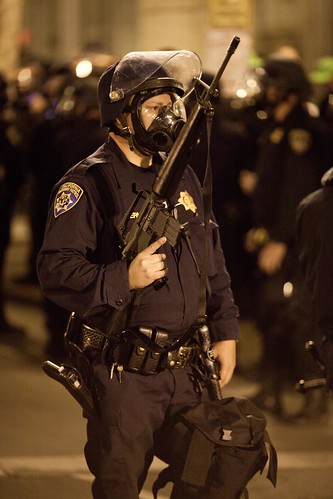 You can see the clearly angry and upset, but restrained, crowds with their signs, making their speeches, demanding the justice they didn’t get. You can also see the police, in full riot
 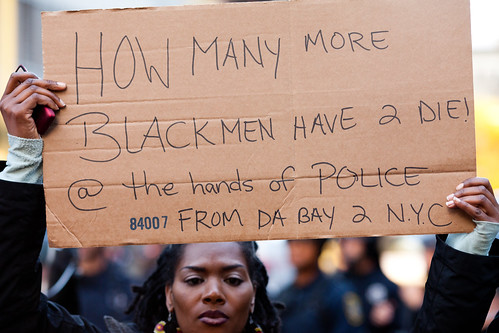 gear, looking like something out of a 1960s picture of the South, utterly stupid in their mis-match of armor. Assault rifles in hand, assault rifles against cardboard protest signs.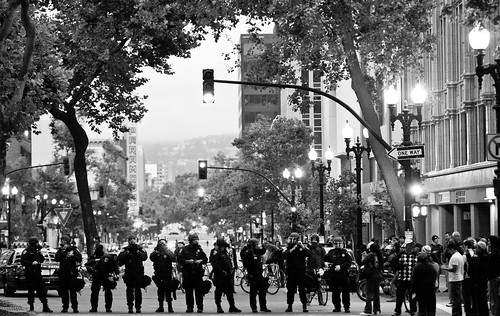
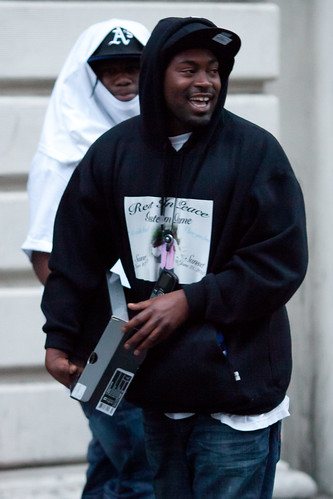
 logo on the side; they don’t get you on the train for free. How about just jumping the toll gate at BART instead?