Showing posts with label race. Show all posts

Monday, August 31, 2015

Reflections upon finishing Spectacle: The Astonishing Life of Ota Benga

Sometimes I just hold the pen above the page and wish that it were possible for raw emotion to spill onto it without the need for words or letters or sounds or coherent thoughts.  I suppose artists can do that.  I am not an artist.  I am only human.  An empathetic human fighting to save her soul from the destruction of the masses.  Fighting to find truth despite “the way it is.”

Tears ring my eyes.  The soft patches underneath, beginning to droop with the signs of ma age and lessons of life, are hard with dried salt from tears that escaped some time ago.  Humanity—is anything but.  Cruelty.  Justification  Righteousness for us.  Condemnation for them.

If you want to kill someone, the first thing you do is make them “something.”  Savage.  Negro.  Jew.  Terrorist.  Enemy.  Fetus.  Animal.  Anything but “human.”  Anything but us.  And it is so easy to do.  So easy to draw a line.  So easy to say “me” “not me.”  “Me.”  “It.”  “Me.”  “Those things.”  And once it is done, once the line is drawn, once the leap is made, there is no barrier to the fierceness, the destruction, the uncaring, the harming, the ability to bring pain.

*     *     *

Pain.  Pain.  Pain.

It hurts.

It hurts to receive pain.  It hurts to recognize the immense depths of giving pain of which you are capable.

It hurts to look evil in the face and recognize yourself.  As much as it hurts to look at the broken lying in a heap and see your pain.

I am the broken and the breaker.

I am the shame and the shamer.

I am the victim and the victimizer.

We are.

We all are.

And we call this “humanity.”

And we justify the doing, even as we lick our own wounds.

And there is no end.  Only a new sense of us and them.  Only a new line drawn, even as we express horror at the old one’s place.

Spectacle: The Astonishing Life of Ota Benga purports to be an account of a young man exhibited in the monkey house at the Bronx Zoo in the early 1900s, but it is so much more than that.  It is an unabashed look at global race relations, America’s role in the rise of eugenics and the influence of her preeminent scholars on Adolf Hitler, a gasping account of King Leopold’s horrors in the Congo, and a brave attempt to make an “other” one of “us.”

Sunday, April 26, 2015

Why “Don’t Resist” Advice is Not the Solution

Sitting on an airplane, the man in front of me was watching 12 Years a Slave.  I glanced up.  Two men were just hung.  A third was passing and was kicked by a white man to move along.  The hung – as being hung - looked at him, at the man passing, with what in their eyes?  Not pleading.  I don’t know.  He looked back knowing it was their last look, and they were hung.  Bodies twitching violently in the air, high above the crunchy brown leaves and the stained hats of the stained white men.

This is why “don’t resist” is not an acceptable answer to the pervasive police brutality against black men in this country.  For over 200 years, we have told black men they have no dignity.  We have emasculated them with commandments that they obey our orders and our force or die.  To tell them the solution to not dying is to just obey is not ok.

“Obey, and fight it later in court,” and this, somehow, is supposed to be “justice.”  Without even getting into the skewedness of that system, even if they “win” by not having charges filed or by getting a case dismissed on a 4th amendment violation, their dignity has still been taken.  There is no justice for that; there’s no getting that back.  The closest they can get is a civil judgment or settlement against an officer or a department by their family after they’re dead – or maybe, in extremely rare cases (Walter Scott), a Colors of the Wind quote murder charge against the officer.

The solution is not “don’t resist.”  The solution is showing respect and acknowledging dignity.  It is officers treating human beings as fellow men – not “others,” not “criminals,” not “thugs,” not “pests,” or “suspects” or “perpetrators.”

A lady who had testified during the Congressional Briefing on The Justice Package said on the news, “it’s the system, not the officers.”  Well you know what? The officers are the system.  And until they can treat other humans – black humans, black male humans – with respect, the system will not change.

“Do not resist” is not the answer.  It only addresses the symptom of “death in police custody.”  It does not address the problem, the raping of black men’s dignity, the continued degradation and emasculation of the American black male. 

Wednesday, March 11, 2015

The skinny white fat Nigerian in my head

Note: I usually do a book review post when I finish a book.  But I decided to do something different with Chimamanda Adichie’s Americanah and instead share thoughts and comments in a pseudo-real time.

The protagonist is a fat Nigerian.  We know this within the first page or two of the novel.  But the image in my head is a faceless slender white woman.  The same image I’d have for Elizabeth Bennet.  I realize this.  I try to change it.  I try to think of one of my larger Nigerian friends, a well-off woman who I can’t call fat because she’s lived abroad enough to consider it an insult coming from an American.  It doesn’t work.

I keep reading; the image changes.  As Ifemelu grows, the image in my head flushes itself out.  It begins with Ifemelu’s flashback to her school days in Lagos.  The image begins to take the form of a slender African teenager, drawing on any number of the girls in my Zam-fam, my village, or around the neighborhood in Abuja.

When Ifemelu immigrates to America, when she’s new and lost and navigating the strange straddling world of her aunt who has already been in America for some time, the image grows.  It becomes easy to fit each new bit of her into the image in my head.  Her clothes change.  Her attitude changes.  Her hair changes.  She relaxes her hair; she practically shaves her head; she grows and afro.  These changes manage to stick -  although for some reason she has a blonde afro – not white girl blonde, dyed honey blonde.  This protruding of my subconscious strikes me as odd again.

As the scenes pop back to the present, the Ifemelu in the hairdresser’s chair becomes a large, Nigerian woman with black hair being put into braids, puffs of unbraided hair sticking up in front.  An Americanized Nigerian woman who’s become bitter and condescending in ways that would probably surprise her young self (but fit perfectly into the developing image in my head). 

It takes at least half the book before this Ifemelu, the one described on page two, can finally take shape in my mind.

It bothers me a bit, that I cannot take a written description and make an image of it; that my defaults are so ingrained that it takes 200 pages, 200 pages of slow growth and character shaping, to get to something close to the written description.


… For some reason, I did not have the same trouble with the male lead character, Obinze.  Perhaps because my first introduction to him was as a school boy.  By the time he showed up as an adult, he’d morphed into a melding of Kevin Hart and Idris Elba.  I’m guessing the combo is because Obinze is described as not tall.


Apparently Lupita Nyong’o is going to play Ifemelu in the film.  I’m having a really hard time picturing that.  She’s so tiny and doesn’t look at all Nigerian.  At least the actor they have for Obinze, David Oyelowo,  is Nigerian, even if not Igbo like the characters.  Of course, they’re both such stellar actors, they’ll probably pull if off splendidly.

Thursday, September 4, 2014

The Privilege to Choose

The thoughts for this blog post have been in my head for awhile, but I haven’t been able to formulate things into words.  I’m just going to sit down and write and hope I can express this somewhat intelligibly, because it’s a very important topic.

My last couple serious relationships were with black men.  I’m not saying that for some sort of “see, I’m not racist” point.  In fact, what I’m about to say is more likely to prove I am.

My last serious relationship was with a black man in America.  At some point in the relationship, as a woman is apt to do, I started thinking about what it would be like to have children with this man.  What they might look like, how they might act, what kind of mother I’d be, what kind of father he’d be.  I found myself wondering if I could really keep going with this relationship.  I legitimately questioned whether I could stay in a long-term relationship with a man because he was black

You see, if I were to have children with a black man, I would have black children.  Could I handle that?  Could I handle everything that meant?

There was the easy stuff.  If I had a daughter, she wouldn’t look like a little me.  I wouldn’t know how to do her hair. Etc.  But if I had a son,  could I handle it?  My son would be light skinned, half-white, but to society, he would be black.  He would be a black man.

Black men wind up in jail.  They wind up on church fans and screen-printed T’s.  They wind up in chalk lines on the news.  Black men wind up as hashtags.

Statistically, my son would be 3x less likely to graduate from high school.  My son would be nearly 10x more likely to go to jail.  My son would have a shorter life expectancy.  My son would be more likely to be in a gang, more likely to die in a violent crime, more likely to be harassed, targeted or killed by the police.

Yes, the odds on some of these things can be changed based on location, schooling, parenting, etc.  But nothing, nothing, can completely erase all the extra risk that comes with being a black man in America.  Names like Trayvon Martin, Michael Brown and Oscar Grant are still fresh in our minds.  Take also Caleb Gordley, a black male teenager, with a white father, who lived in a wealthy neighborhood and attended good schools, who was shot and killed by a neighbor when he accidentally entered the wrong house in the middle of the night.  There’s how many hundreds more stories.  We know it.  We hear them.

As a mother, I’d be carrying all this.  I’d be the one sitting up late at night worrying the worst had happened when he wasn’t home on time.  I’d be the one teaching him to keep his hands on the steering wheel until the officer was next to his window and talking to him – something I learned from a black boyfriend and never would have thought of on my own.  I’d be the one letting the police know he would be walking around his own neighborhood.  I’d be the one scared and panicked and helpless.  Could I handle that, could I handle being the mother of a black man?  Did I want to take all that on?

In the end, I decided yes.  I cared about the man I was with and if we would be together long term, I’d want a family, no matter what our children looked like.  The simple fact that I could make that decision, that I had a choice, that I could walk away from the risk and pain, exemplifies what it means to be white in this country.  No other race can do that.  A black woman can have a child with a white man, that child will be black.  A Latina woman can have a child with a white man, that child will be Latino.

As a white woman, I can choose the color of my biological children.  Let that sink in for a moment.  I. have the ability. to choose my child’s race.  That, my friends, is just one example of white privilege.

Thursday, June 27, 2013

Ndili Mukuwa, and It’s Ok

I’ve always been acutely aware of my “whiteness.”  In kindergarten, it was benign, meaning only that I couldn’t do as much fun stuff with my hair as some of the other girls.  By first grade, it was that other people’s not having as much or being downtrodden was my fault as on Martin Luther King Jr. Day we were taught “white guilt.”  By fourth grade, I was evil, inhumane, cruel, for beating all those slaves before the Civil War. 

In high school, added to all this was that I simply wasn’t cool enough to talk to the groups of black students.  By college, all the guilt and meanness and cruelty and uncoolness, added to the fact that I’d never be able to dance or jump, had me paralyzed with fear.  “I can’t talk to you.”  “I don’t know how to talk to you.”  “I’m not good enough.”  “I’m not cool enough.”  “Everything bad that’s ever happened to you is my fault.”

So I did what anyone does when they’re totally afraid.  I ran away.
To Africa.

Here, it was different.  I was different.  New stereotypes were flung at me, but I didn’t buy into them.  Maybe it was because they were delivered to me by individuals instead of society as a whole.  Maybe it was because I knew them to not be true with respect to myself.  How come I always accepted that the stereotypes back home were true?  Indoctrination at a young age?  Societal reinforcement?  Not grown up enough to know myself?  I started to realize that things I’d believed about myself weren’t true.  I was me. Me. Alone. Me. Not the billions of other people in the world who had come before me and happened to have something in common with me.  Me.

I had been taught that “racist” was the worst thing you could ever be called.  My fear came from fear of that word.  In Africa, the worst thing I was ever called was Mukuwa/Muzungu/Onyibo and that isn’t that bad.

Now I understood.  Just because someone calls you something, doesn’t mean you are such.  I was, am and always will be Mukuwa.  But in some ways, I was also correct when I’d yell back to those “Mukuwa!” screaming kids, “Tandili mukuwa, ndili Ba Tonga.”  I am not a foreigner; I am one of you.

There may be times when I am racist, but it’s because of me, my thoughts, my experiences, not because of all those people I never knew in all those places I’ve never been.  I’m me. 

Sometimes I’m good; sometimes I’m bad.  Sometimes I’m right; sometimes I’m wrong.  Sometimes I’m cruel and unfair; sometimes I’m compassionate and generous.  But I am not afraid of what I am anymore.  Africa gave me that.  That, and some of those hairstyles I’d been wishing for since I was a little girl.

Friday, April 27, 2012

Book Review: The Slaves’ War

It was one of those books that I ordered expecting it to languish on my shelves until I should happen to be in the mood for it. Though it sounded terribly interesting, interesting enough to prompt me to buy it, it was thick and had the sort of college-course-assignment vibe to it. But it didn’t languish nearly as long as I expected, and my expectations for how long it would take me to finish were even more exceeded.

The Slaves War by Andrew Ward is billed as “The Civil War in the Words of Former Slaves,” and that’s exactly what it is. Woven together with more standard historical battle accounts and report from generals are first-hand accounts from slaves collected during several interview projects in the early 20th century.

The book is arranged in chronological order, covering from just before the war through some of reconstruction. It’s incredibly interesting to see how the slaves’ ideas about and reactions to the Yankees change as the war goes on.  From an initial fear of an unknown described to them as a monster, to an almost idolizing, to disgust, distrust and near hatred, there’s a very visible evolution that comes with the war, occupation and Reconstruction.

Nearly every anecdote popular about slavery and the Civil War seems to come out as true in some area another. The South was (is) a big place and there was great variety among slave-holders, slave treatment, and direct effects of the Civil War.  Some stories of society in the mid 1880s seemed to have a striking resemblance to aspects of current society. Stop snitching has deep roots.

But for me, the most striking part of the book was this photograph from the Library of Congress,

Five generations on Smith's Plantation, Beaufort, South Carolina

which immediately brought to my mind this picture,

zam fam

and reminded me of Ba Faye (fourth from left, back row) telling me while we were picking cotton that she wished someone would kidnap her son (front row, 2nd from left) to make him a slave because then he would be in America.


I recommend the book.

Note: My “Zam Fam” pic also appears on the post “Mosquitos Kill, Kill Mosquitos” from October 26, 2008.

Sunday, November 7, 2010

Being a Black Man - Book Review

Race is a difficult subject to write about.  Though I’ve touched on the subject a few times, I generally avoid it, sometimes discarding half finished posts that aren’t coming out right.  But, I made a deal with myself that I’d write about the books I read.

imageThis week, I finished a book called Being a Black Man.  It’s a collection of essays from The Washington Post and should really be called Being a Black Man in Washington D.C.  Each essay focuses on one or two different people, and every single one of those people lives in the Washington D.C. metro area.  Most of them in one community in Maryland.

However,

Overall, I found this book very, very frustrating to read.  The book has a number of interesting articles, including one about a hair dresser who was wrongly arrested and a black republican from the South who is still half-shunned by his home town for his political choice.  The frustrating part was just seeing how much some people still blame on racism, as if everything that goes wrong is because they’re black.

[Note: the article about the wrongly arrested man was also very angering to read, because of the sheer incompetence and stupidity exhibited by our criminal justice system.]

No Job, No Fault

There was one guy who’s unemployed.  Why is he unemployed?  Because most black men are unemployed.  The numbers of black unemployed are something like 6x greater than the number of whites unemployed.  (Or was in 2006, before the big crash.)  This guy had a job, a good job that was steady, paid well and was full time.  What happened?  He got bored.  He quit.  He quit before he had another job lined up.

Boardroom Blindness

Bob Johnson, founder of BET, complains that there aren’t enough black CEOs and company owners because getting those positions is all about networks and knowing the right people and being in the  good ol’ boys club.  Black people don’t know the right people; they don’t have the connections; they aren’t in the good ol’ boys club; that’s because of racism and that’s what’s keeping down black people, he says.  But there are thousands of people of all races, including white, who don’t know the right people, who don’t have the connections, who aren’t in the good ol’ boys club.  I’m one of them, most of my white male friends from high school are also in that group.  This is a social and economic thing, not a race thing.  Unfortunately, race and class are so often correlated, it’s sometimes hard to see them separated.

It’s My Great-Great-Great-Great Grandparents’ Fault I’m Not Married

By far, the most frustrating article for me was the one article focusing on a black woman.  It was about the lack of eligible black males in the dating pool.  I get that this is an issue, that the numbers, even when you count the young men in prison (which is a lot) are horribly skewed.  And I get that some women don’t want to date outside their race, and that’s fine. 

What irked me was that this woman’s behavior and that she blamed her inability to find a husband on slavery.  Yes, slavery.  Despite the fact that research cited in the article shows that the % of black married couples was very high until the 1970s, when it dropped off precipitously.  (Seems there’s a good case here for the real culprit being the white woman’s movement, but I digress.)

As this woman insisted that it was slavery’s fault she wasn’t married, she treated the guy she was trying to date rudely.  She kept telling the reporter about how she’s special, and valuable, and worth chasing.  So she makes the guy have to chase her, making herself difficult to reach, trying to change plans at the last moment without considering the inconvenience she might cause for the guy.  And the guy, since he’s had one five minute conversation with her up to this point, gets tired of it and moves on.  Good. 

Maybe I’m just extra sensitive about this topic because I’ve been at the receiving end of those “how dare you steal our black men” glares.  Because Mr. Trizzle and I have actually had to think about whether it would be appropriate for me to go to certain events simply because I’m not black.  Yes, in modern times, yes in the very diverse Bay Area.   But even if I am sensitive, there’s one thing that remains true:

If You Want to be Valued, Show Your Value

Look, I don’t care what color you are, how old you are, or how many degrees you have.  You probably are wonderful, but the guy isn’t going to know that until you show him.  You can’t just expect him to assume you’re better than other women, that you’re worth it.  Relationships are risky.  They take time and a lot of energy.  Both people want to know if the investment is going to be worth it.  And they want to find out before they start investing too much.

I know I’m worth it, that I’m special and valuable.  But, I had to show that to Mr. Trizzle before he could know.  And I continue to show him I’m worth it everyday, just by being me.  The same way he shows me how valuable he is just by being him.  Self-confidence is all well and good.  I wish some girls who think they’re so very priceless were more willing to show it before demanding something in return.  And especially before blaming slavery for the bumps in their road.

The New Black Youth

One article just made me sad.  It was talking about how youth culture in black communities has shifted so drastically in the past 40 years.  How young black men are afraid to love.  Stuck in a cycle where violence and ignorance are glorified traits.  Where to be calm, to try to talk, or even to want to get an education are seen as sellout traits, going against the community, “acting white.”

Personally, I think this is starting to change.  Due in large part to a shift in urban music and what’s “cool.”  Hip hop and R&B are becoming more pop influenced.  Lyrics are starting to be less about drugs and violence and more about other things.  Stars like B.O.B. changing it up a bit.  The article mentions this briefly, though it uses Chris Brown as an example – written pre-Rihanna fiasco.  And there’s intelligent, educated, high-profile black role models.  Most notably the Obamas.  It may take some time, but this issue is shifting.  A little bit of positive in a negative mess.

Saturday, July 10, 2010

An Injustice for an Injustice?

Some of you may remember a video and a post from shortly after New Year’s 2009.  The murder of Oscar Grant.

Except technically, I’m wrong for calling it ‘murder’.  The jury on the trial of that officer in the video that you see shooting Oscar Grant in the back while Oscar Grant is lying face down on the platform and then, after Oscar Grant is bleeding to death, puting handcuffs on the dying man – the jury in that officer’s trial came back with a verdict yesterday.  A verdict of involuntary manslaughter. 

Those twelve people decided that not only was this not murder, the officer did not intend to hurt Oscar Grant.  Somebody, please watch that video and tell me if you believe the officer didn’t intend to hurt Oscar Grant.   But then a video didn’t matter in the Rodney King trial either. 

Anyway, I could go on about how ridiculous I find that verdict, and why, but I won’t.  I’m not the only one that was angered by this.  Lots of people were, and they took to the streets in Oakland last night to protest.  There’s a beautiful set of pictures of the event on Thomas Hawk’s Flickr Stream

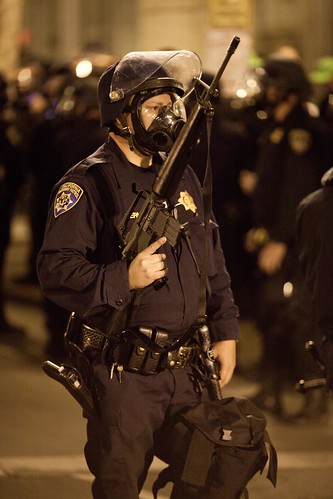
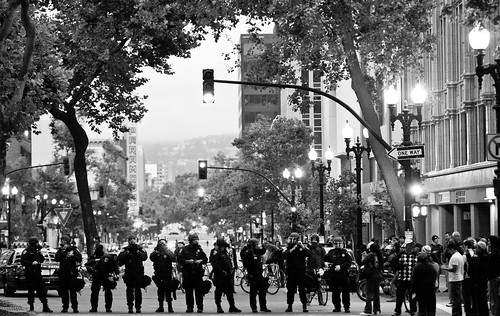
It paints a fitting portrait of the police in light of what happened to Oscar Grant.  The police from all over the area converge on downtown Oakland for the “Oakland Riots.”  The Oakland Riots, considered riots because they were named such by the media before the trial even ended, named in expectation.

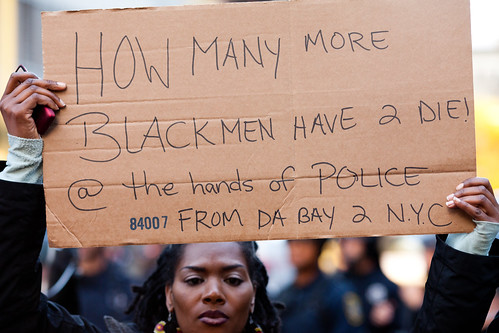
Riot Cop and Assault Riffle, Oakland Riots, 2010 da Thomas Hawk.You can see the clearly angry and upset, but restrained, crowds with their signs, making their speeches, demanding the justice they didn’t get.  You can also see the police, in full riot How Many More Black Men Have 2 Die, Oakland Riots, 2010 da Thomas Hawk.gear, looking like something out of a 1960s picture of the South, utterly stupid in their mis-match of armor.  Assault rifles in hand, assault rifles against cardboard protest signs.

Riot Police Hold Line at 15th and Broadway, Oakland Riots, 2010 da Thomas Hawk.

And then, there’s these guys:

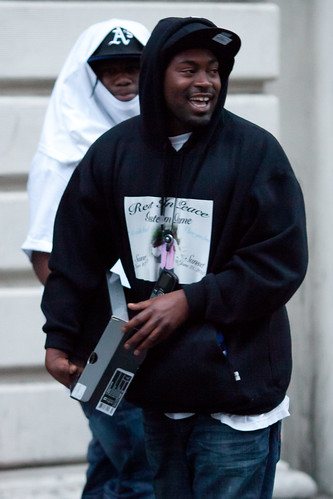
Looter Holds Pair of Shoes, Oakland Riots, 2010 da Thomas Hawk.

who decided that the injustice of the verdict was a permission slip to steal sneakers.  And this is what really pisses me off.  (There are several other pictures of the Foot Locker looting on the Flickr Stream.)

One, how does a bad jury verdict in a murder trial justify stealing shoes?  Ok, maybe in the OJ trial if you were stealing some OJ shoes or something so he didn’t get the royalties.  But stealing shoes because a BART officer got off easy?  They’re not BART shoes; there’s no little  See full size image logo on the side; they don’t get you on the train for free.  How about just jumping the toll gate at BART instead?

Two, why are you busting stuff in your own neighborhood?  It’s your neighborhood!  You’re mad?  Justice wasn’t done?  You wanna break something?  At least go break the officer’s windows so your angry, aggressive, illegal behavior makes some bit of sense!

The protesters were of all ages and races, all styles of dress, from suits and ties to hippie gear.  The looters, at least in the pictures, almost completely 20-30 year old black men in ghetto-styled clothes.  This is not a good look for the black community!  (and I’m not talking about the clothes; those look fine.)  I’m not going to begin to discuss the amount of stereotypes this perpetuates; I get to sad.

This looting of the Foot Locker, this alone almost* justifies the presence of the full-riot gear police in Oakland.  And to some people, as sad as this is, it may even help justify what that officer did to Oscar Grant.  The black community deserves better than that.  Oakland deserves better than that.  Oscar Grant deserves better than that.


[All photos, except the BART logo, by Thomas Hawk, licensed under Creative Commons Attribution-NonCommercial license and available at http://www.flickr.com/photos/thomashawk/sets/72157624455565162/detail/]


*Thomas Hawk gives a good 1st person account of the event, which includes descriptions of when the crowds did turn violent later in the evening and broke windows on other area businesses.  Although I still don’t think assault rifles are ever appropriate against unarmed people, Hawk’s account does show that some riot protection and the heavy police presence were eventually necessary.

Tuesday, May 4, 2010

Sarah Dubois, Setting the White Woman Battle Back Some Years

File:Sarah Dubois.jpgSarah Dubois.  I’m starting to have mixed feelings about her.  I used to be ambivalent, but now it’s growing towards dislike.  I suppose it doesn’t matter much if I dislike her.  She is, after all, just a cartoon character.

But there’s something about the way Sarah’s turning out that is a starting to irk me.  Let me tell you about Sarah.


For those of you who don’t know, The Boondocks centers around the Freeman family, 10 year-old Huey, his younger brother, Riley and their granddad, Granddad.  Granddad moved the family out of Chicago and into a  nice suburb, where they are practically the only black family.

The Dubois’s are the Freeman’s neighbors.   There’s the dad, Tom; he’s a DA and one of the other few black people in the neighborhood.  And he isn’t named ‘Tom’ for no reason.  Then there’s Tom’s wife, Sarah.  She's white.  She’s also very active in the NAACP and often talks about the great times she’s had at protests and marches and what-not.

Sarah’s always been a bit of a naive character, struggling to walk the fine line on which her activities and her marriage have placed her.  A counter-part to her mixed daughter who’s trying to do the same things but whose line is different enough that her mother can be of little help.  Sarah sometimes does ok.  Sometimes she makes mistakes, the same way any of us do when attempting to bridge a gap into a culture that’s not our own.  None of this really ever bothered me.  It seemed a fair, if sometimes painful, depiction.

But lately, during some episodes in Season 2 and the newest Season 3 episode aired this past Monday, Sarah’s character has gone way downhill.  No longer is she just the slightly-out-of-place white woman who’s struggling to find herself in her world.  Now, she is becoming “a white woman” in the said-with-disdain, predatory, despised-by-black-woman-everywhere sense. 

White women who’s main purpose in life is to steal black men away, to collect as many as they can, like trophies.  Forbidden trophies; forbidden, lustful, sexual trophies that desire their blonde hair as much as they desire dark flesh.  It’s a stereotype, and it’s a stereotype that I hate.  (Think I’m making this up?  Google “white woman”; the first thing that comes up is an article about why white women prefer black men.)

The trouble is, this depiction, this stereotype isn’t far fetched.   I know people like this.  Well, really I knew one person like this.  Her life seems to be one giant competition between herself and the rest of the world over who can snag the most black men.  She’s not even white.  But she’s not black either, so she might as well be white; it reflects on us.


For all the comments and criticisms I hear about the ‘bad’ stereotypical ways in which The Boondocks portrays Black People, I guess it’s only fair the show does the same to the White People.   Huey is the revolutionary; Riley’s the ghetto kid; Uncle Ruckus is the black guy who hates black people.  Sarah happens to be that certain kind of white woman.

The general depictions of white people on the show don’t bother me.  But as Sarah’s character depth increases, I find myself more and more…. offended, upset, distraught?  I don’t even know what.  Uncomfortable, that’s probably it.  Why?

My best guess is because I’m afraid of being associated with her.  The other white people, the general mass of white-suburbanites, I can easily distance myself from them.  They’re vague, and general and there’s many of them.  But Sarah, Sarah’s one person who happens to have a few things in common with me.  A few things does not equal everything.  I’m not like her.  I don’t want to be like her.  And more importantly, I don’t want people to think I’m like her. 

White woman syndrome is hard enough to shake off;  I don’t need a cartoon character making it even more difficult.

Wednesday, November 12, 2008

Fear of a Black (with) Hat?

In case you haven't been following along for the last couple of months, I live in Africa.  Everyday, everywhere I go, I am surrounded by black people.  This is not the first time I've lived in Africa, and I also spend plenty of time at home around black people.

Hold on.

I'm not going to go into one of those so-see-I'm-not-racist tirades that often come after someone explains that they have a black friend or two.  I am just trying to explain that I am used to walking down the street and seeing black people, and they don't scare me.  Not saying not racist, just saying not scared.  Got it?

Ok, still think I'm heading down some sort of racist/prejudiced path?  Maybe I am - and that's the problem.  That's why I'm writing this.

The other day I was walking to an American-styled (and priced!) internet cafe on the other side of town.  It's about an hour walk down some pretty busy streets.  I passed lots of people, people carrying things on their heads, people pushing wheel barrows of sugar cane, couples out walking, groups of friends, and the occasional chicken (actual poultry with feathers and stuff).  Some people I greeted, some people I just passed, but mostly, if their presence affected me, it was because a greeting had made me smile.  Even though it was dusk and these were all strangers, I wasn't scared.  I was just walking.

Then, something happened. As I headed up one of the last stocking capmain   streets, I saw a man wearing a stocking cap approaching my path.  Immediately, my heart started pounding.  My eyes darted around, looking for an escape route.  My legs wanted to freeze and run at the same time.  My body was automatically going into panic mode, adrenaline was flowing.

All these reactions happened before my mind had a chance to think.  Something had triggered my flight-or-fight mechanism.  Luckily for me (and probably for the guy, too), my mind quickly regained control, and I kept walking towards the cafe.

But as my heart started to calm down, my brain started going.  Why did seeing a black man in a stocking cap cause such immediate (and irrational) fear?  Would I have reacted the same way if he had been any other race?  Am I afraid of knit hats?  Maybe just headwear in general?

Clearly, I didn't react that way to anyone who looked similar but wasn't wearing a stocking cap.  I have to admit that I really doubt that just anyone wearing a stocking cap would make my heart race like that.  And I know that seeing people I know, of any color, in a stocking cap doesn't scare me.  It has to be something about the combination.  But why?  What has programmed my body to fear stranger+black+stocking cap so strongly?

Thinking back to an account by one of my friends, I can only comfort myself with the fact that I'm not the only person with irrational fears.  Great comfort. :-/

At least this made me laugh:

"Are the majority of black people messed up or is it just where I live?

I live in Oakland, California..."

(Well The Legend, that may explain why that Asian lady yelled at you...)

[*Fear of a Black Hat; Photo from http://blogs.kansascity.com/crime_scene/robberies/index.html]

Wednesday, July 30, 2008

Color: Race or Culture?

Last week, I watched CNN's Black America. During the second part of the special, I realized that I couldn't tell most of the people were black. I mean, CNN was telling me they were black, and they were talking about their experiences as black men/women. But, if I had just seen them on the street, I wouldn't have thought "oh, they're black."

I'm not trying to say I'm color blind. I don't think anyone can truly look at a person and not see any color. But realizing that I couldn't tell who was black without someone telling me made me realize a few things. First, CNN was interviewing a lot of successful people, and they were mostly light-skinned. That's a whole issue in itself, and not where I'm going. Second, it made me really realize there are some people who are very obviously white and some who are very obviously black, and a whole lot of people somewhere in the middle. This led me to one question: how much of someone's color, whether we consider them black or white, is their race and how much is their culture.

Another part of my beginning to think about this came from something that happened to me during my recent visit to Texas. I was at the Dallas Fort Worth airport a few hours before my flight, scrounging for some food. I entered one of the little general stores that had sandwiches on display. The gentleman working at the counter asked if I needed any help. I asked him if they had any sandwiches less than $10. I don't like expensive sandwiches. He pointed me toward some cheaper chicken salad sandwiches. As I was deciding which bowl of fruit to get, instead of the dead chickens, he asked, "are you mixed?" Just like that, just out of the blue.

I was caught of guard, a bit taken aback, yet happy. He was surprised when I told him no. But somehow, I felt like I had achieved something. He was black, and he thought I was, partly, too. It was like a strange acceptance, like whatever I was, it was good enough to be claimed and accepted.

When I told one of my friends about the gentleman's comment, her first question was "do you have braids?" Yes, I do, but I've had them before, and no one's ever said something like that. More often I get, "wow, we don't usually see a white girl with braids." So what's different this time. Maybe it's Texas, or maybe it's something else. Maybe it's what my outside suggested about my culture. mixed me short

I had on a white T with a white bandana, light jeans, giant hot pink earrings, gold high-heeled tennis shoes and my stunna shades. Had I been wearing khakis and a polo shirt with some of those obnoxious rubber/plastic shoes, would he have still asked?

There are a few people at school who are mixed. Some are friends of mine, some just acquaintances. They are generally viewed as either black or white, depending on how others feel they have associated themselves. For example, there are two girls, both in BLSA, both close to the same color. One is a member of a divine nine sorority, takes on major duties within BLSA, and generally hangs out with the other BLSA members. The other doesn't come to a whole lot of BLSA events even though she's a member, is usually found hanging out with her white friends, and, so I've heard, listens to more rock than rap. The first girl is usually just grouped in with the black students. The second girl is often dismissed with the phrase "yeah, but she's white."

I've heard other stories from mixed children, or their families, about society wanting to put them in a box, one race or the other, and how this can cause confusion and frustration. How neither society will fully accept them.

I can't say I know how they feel, I can't say I know about anyone's experiences other than my own. But I'm starting to feel like I've made myself mixed - culturally. It's not like society is trying to figure out where to put me, it knows where it wants me to be, what I'm supposed to identify with. I just won't listen. I'm not sure when that started, maybe in Africa, or maybe when I discovered I like hip hop, or maybe after lots of little things like that came together. Now, I often feel like neither society will accept me. One would if it were deaf, the other might if it were blind.

Trying to have conversations at work or where I live, I often find myself trying to explain things like stunna shades, Bubb Rubb, the Boondocks, or Madame CJ Walker. It often feels like there's a real cultural disconnect, especially when they start talking about bands I've only heard of because my little sister listens to them. Sometimes this disconnect comes up at home too, with my family or old friends. With family, I can chalk it up to us all growing up and finding our own interests. We still have so much in common that the slight disconnects that do exist don't do a whole lot of damage. But with some of my friends, things are a little different. It's hard. A group of friends will start talking about how the problems of the inner city are because families aren't raising their children. How these people just need to be responsible and raise their kids, they can't possibly all be at work all the time. Or about how they all just need to stop having kids underage or out of wedlock. It's such a monoscopic view of the whole situation. I have to bite my tongue to stop myself from getting into embroiled arguments. I don't like to argue with my friends.

Then there's the other side. At school, I can hang out with a lot of people who share some of the same interests I do, and a few people who share a lot of my same interests. It's really nice to have conversations about our opinions and ideas without constantly having to explain what it is we're talking about. However, when I hang out with my friends at school, most of whom are black, there inevitably comes a point in nearly every conversation where I am told I just can't understand because I'm not black. Occasionally, I'm asked to represent and give the opinion of the entire white race on a certain topic. Luckily, this is rare because most of my friends have been on the flip side of this.

Caught in the middle, between my interests and my skin. Sort of between my inside and my outside. It makes me feel the way Ba Lenix described me when he painted the door of my hut with white and black stripes, "it's you, Nchimunya, half Tonga, half mukuwa."

But I'm not mixed. My parents are of German and Polish decent, as far as we know. I'm as white as they come, well after my translucent sister. And I'm not ashamed of my heritage. Bring on the pierogies, polka and sauerkraut. But Polish pride usually revolves around jokes about how backwards Poles are, hanging their Christmas trees upside-down or such. When you do something goofy or wrong, it's the Polish way. And German pride is beer, heavy, fattening foods and lederhosen. It was sort of nice to be identified, for a split second, with a culture full of immense pride, a sort of closed off brotherhood that seeks out its members and welcomes them in with open arms. And for a brief moment, to have someone's perception of my outside match my inside.

Thursday, July 24, 2008

Insons Fino a Provato ... Ater

One of the beautiful things about blogs is the sharing. Not just the sharing in the posts, but also the sharing through other features. For example, on my blog there's a list of other blogs I like to read. (Look, it's there on your left.) This list is here partly to make it easier for me to see when people have updated and partly in the hopes that you, my readers, will try out these as well. Many of my friends have these blog rolls on their blogs. One of my friends even has two, he has one with his friends (like me!) and one with other people with whom he has something in common.

I read a post on one of these extra blogs the other day that made me shudder. To sum it up in the impression it gave me, a girl insisted criminal defense attorneys are the scum of the earth and should all die. Now, none of the language is actually in there. What she really claims is that there's a fundamental difference between these horrible people and good people like her, and she can't understand how they sleep at night and can't wait to punish them personally in court. But what really struck me was my first thought. I read this post of hers and immediately thought "well you certainly aren't black."

Tonight I watched CNN's Black in America. In some ways it reinforced the reaction I had. Tonight's episode discussed women and families. Tomorrow's will discuss men. Tomorrow will probably bring it home even more - why that was my reaction, I mean.

On the post, the girl says, "it takes a special kind of scum to defend rapists, drug dealers, and murders." I don't know what upsets me more, that she thinks all these people are automatically scum, or that she assumes they're all guilty. (And she wants to be an attorney!)

The CNN show covered a lot of different families, with a lot of different stories. Many of them highlighted the difficult situations in which people can find themselves. A single father working to raise his two kids gets evicted because the landlord is switching the property from apartments to a single family home. At the end of the segment, he's looking for a new place, but it's possible he and his two sons may need to go back to the homeless shelter. His son may have to start 5th grade at his 5th school. Stories like this play themselves out everyday in our country. And when a young boy grows up a bit and finds himself dealing drugs because it's the only way his family can get some money, or in a gang because it's the only way he can walk to school without getting shot, is he scum?

Sometimes people make poor choices, sometimes people act rashly in a flash of emotions, and sometimes people just wind up (being the wrong color) in the wrong place at the wrong time. None of this makes them scum. Are there some cold-hearted scummy people out there? Yes, I'll nominate Scott Peterson for one. But I will not nominate the drug dealers that I know are just down Telegraph. I will not nominate the confused young man whose culture has taught him to hear one thing and think it means another. And I certainly will not nominate the defense attorneys.

Scum or not, everyone deserves a fair trial with representation. It may not happen often, but if even the attorneys don't believe in it, goodness! we're all vampired.

(If you'd like to see the original post, it's here. But be forewarned, the author doesn't always post comments if she disagrees with them.)

Thursday, May 29, 2008

Looking Through Rose-Colored Glasses or Tinted Windows?

Our view of the world, no matter who we are, is influenced by our interactions with others, our experiences, and the way other people react to who we are. It is also based on how we have seen people act, in person and through history, towards others with whom we identify. We think to ourselves " I am like A because we have x in common. B acted this way towards A because of x, therefore B will probably act that way towards me." Eventually, this fairly logical conclusion can stretch to the extreme of "B has y in common with many other people, and B acted in this way towards A because of x. Therefore, anyone with y will probably act that way towards anyone with x." Voila! a stereotype is born.

I thought anyone expressing frequent offense in everyday situations must simply be jumping to this extreme conclusion, focusing on stereotypes and searching to find harm in innocent behavior.

A Year and a half in BLSA, I have to say my perspective has changed. Willingly, or unwillingly, it has done so. I've met some people in my life who seemed to always look for racism. Any comment, any action, anything at all exemplified the racist bent of this country and every white person in it. (These people are often eager to explain that black people simply cannot be racist because they're a minority and thus unable to oppress anyone.) Now, I'm not so sure these people are looking for racism as much as it is trying to smack them in the face.

Several years ago, when I was in college, a song came out called Beer for My Horses (listen). Back then, Toby Keith's rousing duet with Willie Nelson conjured up pictures of the old west. I'd see John Wayne entourage types riding their horses through a desert landscape, chasing some outlaw with their lassos flying. The rowdy group would settle into a wooden saloon. With boots on the table and hats pulled low on foreheads, the dingy regulars would watch the dirt stained heroes celebrating and tossing back whiskeys. The bartender, with his waxed moustache and garters on his sleeves stood outside pouring beer from a barrel into the horses' trough.

Last week, I heard the song again. This time, the images on my internal movie screen had lost their innocent silliness. I was not trying to think of anything specific. I wasn't even really paying attention to the song at first; it was background noise to the hum of the sewing machine. But I started to feel uncomfortable, annoyed and angry. Subconscious reactions to the song forcing themselves out. Only a year and a half as a visitor to a small subsection of the black community, and the offense to the song was immediate.

"A tall oak tree"? "All the rope in Texas"? After a classmate in my History of Race and the Law class interviewed another classmate's relative about a lynching that occurred near her home town during her childhood, after Jena, after learning and talking and reading about a whole history of trees and rope and black men, how could these lines evoke anything other than immense repulsion? And just who are "all of them bad boys"? It doesn't help that, for me, this phrase immediately conjures up images of black men, the Bad Boys movies, Diddy and Biggie and Bad Boy Entertainment, etc. (And of course, I hear the theme song to Cops.) I wasn't trying to put together the worst possible meanings. These are my normal associations based on my life, on the popular culture with which I have come into contact.

By the time the song got to Willie Nelson's verse, I had realized I was hearing the song from a new perspective, and had focused more on the words. He started singing about "gangsters" and "crime in the streets". I recalled one of my friends in BLSA discussing why she believes words like thug and gangster have become a substitute for the n-word, being used to express the same sentiment without the backlash. I thought about all the conversations at school with my friends about hip hop, about crime, about statistics and stereo-types and the latest ignorant doings of some pseudo-star. From that perspective, even "crime in the streets" seemed to have a definite racial slant. It doesn't help it's a country song by two southern white-boys.

I don't think the song is actually racist, or has any real intent of expressing such a view. (Especially in view of the video.) But, I can see how innocent, harmless fun, can appear otherwise when the background and context it is put against gives things another distinct meanings. The trick is trying to separate interpretation from intention.

.... and I do still think there are some who would prefer to willfully misunderstand things and assume racism than to get on with life.

(Original Post)

Bedroom

Thoughtful

Toby Keith - Who's Your Daddy

Tuesday, May 27, 2008

Because Discrimination in Hiring is Illegal....

Email received today: (names and locations redacted)

My name is XXXXXX and I am an Assistant District Attorney here in
XXXXX, XX and formerly the President of the University of XXXX
School of Law BLSA Chapter. I have been an ADA for almost 4 years.
Our office prosecutes cases in XXXXX, XXXXX and XXXXX Counties.
Though my office has not officially posted openings, I know that we
have 1 and possibly 2 openings for an opening starting this summer for
an Assistant District Attorney. We are currently interviewing. This
office has previously hired attorney's before receipt of bar results.
We will also hire unpaid interns this summer as we have previously.
Last year we hired 5 unpaid summer interns (one to each trial team).
If there are any BLSA members, more specifically, African American law
students interested in applying for a position as an Assistant
District Attorney or summer intern, please have them forward their
resumes to my attention and I will forward to those in charge of
hiring. Time is of the essence.

Really, people. And this is equality?

(Original Post)

Bedroom

Irritated

Rihanna - Umbrella

Wednesday, March 26, 2008

Do Those Boxes have a Purpose?

Those stupid boxes. What purpose do they serve? Diversity? So all white people are the same? That seems to be the stereo-type and it's probably the one I hate the most.

We had a program last week at school: "Shades of Black." It was incredibly interesting and informative. I don't think I have ever felt more alone in my life.

A girl was talking about how "blacks" in America are really a diverse group of cultures and how white people need to realize this, and not group everyone together just based on skin color. In saying so, she had just turned around and done the same exact thing to "whites." Nobody seemed to see; nobody said anything. How that stung!

Many people talked about different stereotypes or manners or dress or food, and the general response was, 'well that's really regional, it's not race.' Tuche. The same for each side.

(Original Post)

Ren Room

Frustrated

Keys and Voices

Tuesday, March 25, 2008

Please Check the Appropriate Box

When I was a little girl, we had to bring home various enrollment and emergency contact cards from school. My daddy would take the cards and, where the boxes for race and ethnicity were, do one of two things. He would either check "other" or cross out "white" and then write in "Central-European American".

At first, I thought he was just being technical Daddy. But he would exclaim, 'if all the other people get to be classified by their ethnicity, why don't we?!" But Daddy was on to something. "African-American", "Pacific-Islander American", "Hispanic-American", "Native American", "Asian-American" and "white", Why don't I get a hyphen, or an "American"?

As I've gotten older, I've come to agree with Daddy on this. (Not sure how often that happens.) And now I'm the one who gets to check the box. I usually select the newest addition, "Prefer not to say." (Which on on-line surveys is usually followed directly by "are you hispanic?") As long as everyone else gets to be classified by their heritage and I'm supposed to be classified by skin color (in mid-winter), I'd prefer not to answer. When there's a box to check for "German-American", or "Polish-American", then maybe I'll answer. It's not like checking "white" is going to help me anyway.

(Original Post)

Bartholmew Room

Discontent

Humming of Heater